Showing posts with label skimming. Show all posts

Sunday, February 08, 2009

The $9 Million Electronic Robbery at RBS WorldPay

With the Heartland Data Breach still fresh in the news, word of a $9 million heist using data from another payment card processor (RBS WorldPay) has hit the air waves. RBS WorldPay reported in December that their payroll card system was hacked and 1.5 million financial and 1.1 million personal records were compromised. Payroll cards are used by employers to pay their employees by loading their pay onto a debit card.

A Fox News investigation has now revealed that on November 8th, a coordinated attack netted $9 million using cloned cards in 49 cities, worldwide. The attack occurred all over the United States, Montreal, Moscow, and Hong Kong in about 30 minutes.

Another scary aspect to this attack was that the hacker was able to remove the daily withdrawal limits of the cloned cards. According to the Washington Post, 100 cards were used and fake deposits were used to refuel the balance on the cards. Large withdrawals were then made again and again on the cloned cards. Please note this represents that a very small percentage of the total cards compromised were used in scheme. No information was available on how they refueled the accounts.

I've seen accounts refueled using bogus checks, however in this instance, I would suspect it occurred in a more electronic manner. This leads me to believe we will see more disclosures regarding this case as time goes on.

According to official reports, there are no primary suspects in the case. Photographs of some of "lower level soldiers" used to withdraw the money have been released in the hope that (if caught) they will provide information on the people, who provided them with the cloned cards. Unfortunately, with the anonymous nature of the Internet, coupled with the fact that chat-rooms are often used to facilitate the distribution of stolen data, the lower level soldiers might not know the identities of the main players, themselves.


In the recent Heartland breach, it was disclosed that they met PCI DSS (Payment Card Industry Data Security Standards). According to Visa's list of PCI DSS certified vendors, "RBS Lynk" (Royal Bank of Scotland) is certified. PCI DSS standards are the payment card industry's solution to protecting their data from being misused.

I also discovered that RBS World Pay and TrustWave put out a press release in 2007 announcing they were providing level 3 and level 4 merchants with a specialized data security service to identify their risks and vulnerabilities. The idea behind this service is to help these merchants become PCI DSS compliant.

Interestingly enough, TrustWave also certified Heartland in 2008, according to the article I read in Dark Reading.

PCI DSS has been criticized as being expensive for merchants and now we are seeing it compromised, too. The sad thing is that despite a lot of money being shelled out to become PCI DSS compliant, the people shelling it out seem to be just as vulnerable as they were before. In fact, someone might conclude that PCI DSS is giving everyone a faux sense of security (opinion).

As usual, in these cases, a class action law suit has been filed against RBS WorldPay. WorldPay has also announced the cardholders will not be held liable for the charges, according to the page on their site about this matter.

Thus far, according to all the sources I read, no identity theft has occurred. My guess is that because the 1.1 million people compromised are monitoring their credit, none will occur in the short-term. In most of the many breaches I've read about, very little of the information was used after the breach was disclosed. If you think about it, this makes sense because measures have been taken to make the information useless to criminals.

To close, I would like to add another thought. The fact that payroll information — which included personal information — was hacked might point to another example of how storing too much personal information in too many places is the root cause of the problem.

There has been a push to put everything from payroll to government benefits on payment cards. When this occurs, personal information as well as the financial data used to produce the debit card accounts is stored to process the transactions. Since employers (and the government) use vendors (card issuers) to accomplish this task, this means we have sensitive information being transferred to third parties. It wouldn't surprise me if these third parties transfer the information somewhere else when they outsource it, all over again.

Perhaps, what is needed is a common sense solution to the problem. As long as we keep sending information all over the place, it creates too many points where it can be compromised. The bottom line to all this is we appear to be making it too easy for criminals to take advantage of the situation.

The costs are getting out of control, too. Although I've never seen any information on how much of this is going on, the Washington Post quoted a source from the security industry (Ori Eisen, 41st Parameter) as stating $50 million was lost in one month in New York City alone last year.

I wonder if any of our bail-out (taxpayer) money is being used to cover these losses. Although, I can't say for sure, the people it was given to can't seem to say where it has gone, either. Granted, it might be a long shot, but the money had to be given to cover losses caused by people who were a little too greedy in the first place. We need to wake up and realize that there is no free lunch and the costs of all these types of scenarios are passed to all of us when history is written.

There is no such thing as zero fraud liability!

Monday, August 11, 2008

This Year, Fraud Will Cost Businesses $994 Billion in the U.S.!

U.S. organizations lose about 7 percent of their revenues to fraud, according to the Association of Certified Fraud Examiners. When compared to the projected U.S. Gross Domestic Product for 2008 -- 7 percent equates to $994 billion.

In their just released Report to the Nation on Occupational Fraud and Abuse, the average case cost a business $175,000. In a quarter of 959 cases used to compile the study, the loss was $1 million or more. The most costly type of fraud was financial statement fraud -- more commonly known as cooking the books -- which cost organizations an average of $2 million.

Not surprisingly, smaller businesses suffered the greatest losses. I say not surprisingly, because smaller businesses normally can't afford dedicated resources to detect and prevent fraud. For small businesses, the average case studied cost about $200,000.

The most common type of fraud found in the study was corruption and the second most common was fraudulent billing. The average scheme wasn't detected for two years and the most common form of detection was from a human being tipping off management, or a business owner.

In the small business fraud model, check tampering was a common cause, also.

Businesses that had fraud controls did a lot better than businesses that didn't, according to the study. For instance, businesses that did surprise audits suffered an average loss of $70,000, while businesses that didn't suffered an average loss of $207,000. Other controls that made an impact cited in the report are anonymous hot lines, training management to detect fraud and hiring dedicated personnel to detect and resolve fraud.

According to the report, fraud perpetrators can be identified by the behaviors they display. These include living beyond their means, financial difficulties or even by trying to please their boss by making it appear that the business is doing better than it really is. Please note that in the case of larger corporations, the word "boss" can mean investors or shareholders.

Please note there are many more signs of dishonesty and recommended controls for small business owners. Another good resource to read about these subjects is put out by the National Association of Veterans' Research and Education Foundation.

The extensive report covers all type of fraud, whether they are financial, or otherwise. The three main categories it is broken down into are Corruption, Asset Misappropriation and Fraudulent statements. Corruption schemes entail bribery, conflicts of interest, illegal gratuities and economic extortion. Asset Misappropriation schemes (most common) cover cash manipulation, inventory theft, and fraudulent disbursements.

For those businesses, who can't afford hired help to deal with fraud, I guess this means a owner should check their books and accounts randomly without letting their employees know when they are going to do it. They should also diversify controls and oversight (separate key duties). No one person should have complete control over a revenue stream or valuable asset. Additionally -- there are third-party anonymous hot line services and if they are too expensive -- a creative small business owner might set up a telephone line with a voice mail and have some posters made.

So far as training management and employees on what to be aware of -- the current AFCE report is a wealth of information, also. A little awareness and knowledge of how fraud is facilitated can go a long way towards preventing it, as well as, giving your human resources the knowledge to spot and report it.

Most fraud is defeated by people, who are knowledgeable of what to look for. This is because fraud schemes rely on tricking everyone else to think nothing is going on.

On a final note, if you are a small business owner and detect fraud, I recommend leaving any legal recourse matters to someone who is familiar with how to do it. Handling these matters the wrong way can add to the problem by causing other losses, such as civil litigation or the protecting yourself against it. In any situation, where a crime is detected, the best thing to do is to contact the authorities and seek their assistance with it.

Tuesday, March 18, 2008

Hannaford Brothers data breach might reveal current security standards are outdated

Hannaford Bros. Co., a grocery retailer based in the Eastern United States is the latest corporation to be victimized by a substantial data breach. Saying that, customers of Hannaford Bros. are going to be victimized, also. So will a lot of financial institutions, who have to deal with the fraud claims and trying to prevent the information from being used.

Whenever a data breach of this magnitude occurs, there are a lot of victims.

This breach occurred despite that fact Hannaford Bros. had met the payment card industry (PCI) standards for data protection and were not using wireless technology to transmit unencrypted data. Both of these factors were said to have caused the now infamous TJX breach, where approximately 98 million records were compromised.

This time only a reported 4.2 million records have been stolen, but it's still early in the game and historically these estimates tend to blossom with time.

A press release from Hannaford revealed that no personal information was stolen in this occurrence and that only payment card (credit/debit) card numbers are at risk.

Additionally, there have been 1800 reported cases of fraud tied into this data breach thus far.

Today, the AP was able to get a comment from their corporate headquarters:

It was during the card approval process that more than 4 million customer accounts at grocery stores in the Northeast and Florida were exposed to fraud, even though the company meets the latest standards for data security, a spokeswoman said Tuesday.

Hannaford Bros. Co. doesn't yet know how the breach — which began Dec. 7 and ended March 10 — occurred, said Carol Eleazer, vice president of marketing for Hannaford, based in Scarborough.

About 4.2 million credit and debit card numbers were exposed and at least 1,800 stolen during the seconds it takes for that information to travel to credit card companies for approval after customers swiped their cards in checkout-line machines, Eleazer said.

Brian Krebs of the Washington Post, who does the Security Fix blog quoted an industry expert, Bryan Sartin at Cybertrust as stating:

"I would say a trend we're seeing hitting a lot of retailers right now is that these organizations can be [compliant with the credit card industry security standards] and still have customer data stolen," Sartin said. "The data in transit is allowed to traverse private links and internal infrastructure without being encrypted, and the attackers are taking advantage of that."

Once these systems have been compromised, Sartin said, the attackers typically eavesdrop on the network using "sniffer" programs that can extract credit and debit card data as it moves across the wire, before it even leaves the store's network.
If the theory in Security Fix is pans out (probably will), some precedents might exist for the basic method the hackers used. The incidents, I will reference don't sound as sophisticated as what Mr. Sartin is describing, but they happened about a year ago and hacking methods tend to mature with age.

Stop and Shop was the subject of a data breach a little over a year ago. In this case, PIN pads were being replaced with "look-alike" devices that captured all the payment card details. This hardware was later removed to download all the information that had been captured when unsuspecting customers swiped their cards.

Shortly thereafter, another compromise of this type was reported in Edmonton, Canada. In this case, a blue tooth device was used to transmit the information to a waiting car in the parking lot.

The trend with PIN pad replacement continued with a smaller breach at a grocer in the San Francisco Bay area, Albertsons in April of 2007. At the time, I had the pleasure of speaking with Blanca Torres, who was doing an article on the story.

Interestingly enough, up North in Canada, where payment card skimming has increased six-fold in recent years, an announcement was made that they plan to introduce a smart card. This technology, which is known as "chip and PIN" is already in use in Great Britain and France.

The AHN story about this by Vittorio Hernandez included (what I consider) a sage comment:

But Peter Woolford of the Retail Council of Canada is wary that although the smart cards appear to be effective in reducing incidents of fraud, sinister minds may one day find a way to hack the smart chips. "Anything the human brain puts together, another human brain can take apart," Woolford pointed out.
Sadly, once this all pans out, it will likely reveal that PCI data protection standards can and will be compromised in the future. The reason, I say sad is because a lot of retailers have spent a lot of money becoming compliant.

Throw in all the finger pointing and litigation between the different parties in all these breaches and I fear we're going to be fighting a very costly battle over what is becoming a too common item in the news.

I'll sum this post up with a rant, I wrote when the TJX breach was attracting a lot of attention:

While everyone sues TJX, the criminals are laughing all the way to the bank

Press release from Hannaford about the breach, here. They list a telephone number on it, where more information can be obtained if you think you've become a statistic.

Sunday, March 09, 2008

When will we realize how serious the problem of counterfeit devices has become?

On March 6th, Queens District Attorney, Richard Brown announced a series of indictments against a major counterfeiting ring. Although based in New York City, the group was operating nationwide. The ring was obtained skimmed card information from hackers in China. Subsequent news reports have stated that skimmed information was obtained from hackers in the Ukraine, also.

From the press release:

Queens District Attorney Richard A. Brown, joined by Police Commissioner Raymond W. Kelly, today announced that a forged credit card and identity theft ring based in Queens County and with roots in the Far East has been successfully dismantled following the indictment this week of thirty-eight individuals. The ring was allegedly responsible for stealing the personal credit information of scores of American consumers and costing these individuals, financial institutions and retail businesses more than $1 million in losses over the past year.
Counterfeit identification documents to match the counterfeit financial devices were being produced, also.

DA Brown explains why this is of greater concern than mere financial crime:

Many of the defendants charged today are accused of going on nationwide shopping sprees, purchasing tens of thousands of dollars worth of high-end electronics, handbags and jewelry with forged credit cards that contained the account information of unsuspecting consumers. Particularly disturbing is the fact that, in a number of cases, the defendants are charged with using bogus documents to purchase airline tickets and then using those documents as identification to board commercial aircraft. In the hands of terrorists such documents could have easily undermined the efforts of homeland security and other law enforcement officials intent on keeping our borders and citizens safe.

Given that the scope of this crime potentially crosses three continents, it probably demonstrates different organized crime groups are working together. The potential these items might be sold to people with twisted political and or religious motives isn't too far a stretch.

It has been reported that Al Qaeda training manuals teach their minions to use credit card fraud as a means of financing their activities.

I doubt if most of these criminals could care less, who they are selling them to. Even if they did, the full intent of the purchaser might not be readily apparent.

Suad Leija -- who has been providing information on a major counterfeiting cartel to the government -- says that this was the reason she turned on her family members running the cartel.

This latest example shows that despite a lot of focus on security to prevent terrorist attacks, counterfeit documents are a clear threat to all of us.

Prior to Suad turning against her family, her husband says he tried to get the cartel to let the government use their database as a tool to identify potential terrorists, who might have already crossed our border.

I'm sad to report that the database was never accessed and that the criminal case against the cartel is facing some serious challenges at the present time.

This series of indictments also shows how the Internet is being used to fence a lot of stolen merchandise. Normally, we hear about it happening on auction sites, such as eBay or Craigslist; however in this instance this group had an e-commerce website of their own. This website, Easttrades.com, is still up and running at the time I am writing this.

I decided to run the domain through "Whois" and it’s registered right here in the United States.

Maybe it’s just me, but it appears that we need to take the counterfeiting problem a little more seriously. They appear to be easy to produce and are available to too many people.

They are a gateway for criminals, or worse to commit all sorts of illegal activity. I would love to ask the political candidates running in the current election what they think about this problem.

Unfortunately, my guess is that no one is going to ask them and that this is an issue they would rather not talk about.

Queens District Attorney press release on this, here.

Wednesday, May 02, 2007

Airline employees and correctional officer arrested for credit card fraud

A lot of payment (credit/debit) card fraud is caused by dishonest employees, who skim the information from cards; or might even simply forget to return them to you. And when they "forget" to return them, it might be intentional!

The New York City District Attorney's Office announced:

Manhattan District Attorney Robert M. Morgenthau announced today the arrest of four JetBlue employees and a New York City Department of Corrections Officer for the unauthorized use of credit cards from Jet Blue customers.

Press release, here.

Pretty scary, that Jet Blue (airline) personnel and a correctional officer, who should be people that can be trusted, seem to have given a black eye to their professions.

I saw this story the day after I had to go back to a Del Taco, who failed to return my card to me. After going to considerable trouble to get my card back (which I should probably cancel), I was amazed that no one apologized to me for what had occurred.

They even charged me for the ice tea, I ordered when returning to get the card.

On a more serious note, businesses should always make sure lost payment devices and identification are properly secured. They should only be maintained for a short period of time, then destroyed to prevent someone compromising (using) them.

Many people would be shocked at how often these lost and found items are maintained (sometimes for years) in not very secure places, such as an unlocked drawer.

At least, the Del Taco manager did make me show ID to get my card back, but she didn't do very much to make me rave about their customer service. A kind, or sympathetic word can do a lot of smooth out an unfortunate situation, like this one!

So far as restaurant employees involved in credit card fraud, a lot has been written about this, recently.

Here is my version of what a lot of people have been writing about:

Why it's become TOO easy for restaurant workers to skim payment cards

Please note, it's probably not fair to single out restaurant workers, this can occur at any business that accepts plastic, or even checks.

Wednesday, April 25, 2007

President's Identity Theft Task Force issues recommendations


The Identity Theft Task Force has issued the formal recommendations they've been putting together since May, 2006. The recommendations include feedback solicited from the general public.

The final report is comprehensive -- identifying all the issues that have made identity theft and the financial crimes that result from it -- a major concern in the public eye.

The report does (slightly) downplay the problem of data-breaches, noting no significant increase in financial crimes and identity theft from them. I'm not sure, I completely agree with this, but other's could probably argue this point with me. Despite this, it does make a lot of great recommendations on how to limit our exposure to the problem.

In all fairness, it's very difficult, if not impossible, to identify the original point of compromise in an identity theft case. In most cases, the best guess rule applies. With information being sold over the Internet, the criminal using the information probably isn't sure where it came from originally, either. And even if they were to tell us, most of them can't be considered 100 percent credible.

Underground carder forums seem to be selling personal and financial information, too inexpensively. This phenomenon ties the less sophisticated identity thieves with those of a more sophisticated (organized) nature. Given this, the problem has the ability to expand, rapidly.

As there is more demand, we might see more information being used in all sorts of crimes and Internet access is growing, rapidly.

Congress considered several bills on data breaches in their last session, but failed to pass any of them. Protecting against data breaches is going to be an expensive proposition and my guess is that there is a lot of lobbying going on by the organizations that will ultimately pay for protecting the information better.

The report calls for stricter laws and more aggressive enforcement, which is something that should be taken seriously. In my opinion, a large part of the problem is that identity theft is too easy to commit, extremely profitable, and consequences are minimal, if caught.

Also called for is more cooperation of an International nature, which is going to be a key part of any resolution to what is rapidly becoming a global problem.

The full report can be seen, here.

The Task Force's homepage, which has more good information, can be seen, here.

Sunday, April 22, 2007

Why it's become TOO easy for restaurant workers to skim payment cards

We seem to be seeing a record amount of credit/debit (payment) card fraud recently. The latest is a $3 million scheme -- where restaurant servers were recruited to steal their customer's financial information -- using portable skimming devices, which seem to be easily purchased over the Internet.

Samuel Maull of the Associated Press is reporting:

Thirteen people were indicted Friday on charges stemming from their roles in the credit card fraud, prosecutors said.

The credit card account information was stolen from customers who visited restaurants in Manhattan's Chinatown and other parts of the New York metropolitan area, as well eateries in Florida, New Hampshire, New Jersey and Connecticut.

Full AP story, courtesy of the Washington Post, here.

The Manhattan DA's site has a lot more information on this case, which reveals most of the defendants appear to have worked in Asian restaurants, were extremely organized and traveled the country buying high-end electronics.

The DA press release shows how they were turning the stolen merchandise into cash, which is the goal of most of these criminals:

THOMAS JUNG, JOON HEE KIM, JUN SHOJI, RICHARD LEE, JENG SEAK LEE, PHIL ANG, ALEX KIM and others in small groups to areas within and outside of New York State to purchase high-end electronics merchandise – such as laptop computers, Sony Play Stations, GPS navigation systems, high-end digital cameras and IPods.


PAO provided each shopper with 20 to 40 counterfeit credit cards with the expectation that each “shopper” would make fraudulent purchases in an amount that averaged $1,000 per counterfeit card. If a “shopper” was provided with 30 counterfeit credit cards, the “shopper” was expected to make $30,000 in fraudulent purchases. PAO made the travel arrangements for the “shoppers,” which included airline flights, car rentals, and hotel rooms for shopping trips in New York, New Jersey, Connecticut, Illinois, California, Oregon, Washington, Ohio,
Pennsylvania, and North Carolina.

The “shoppers,” who were paid approximately 15% of the retail value of the merchandise they bought, delivered the merchandise to PAO, who then sold the stolen goods to defendant JOHN DOE. In turn, DOE sold the goods to electronics and computer stores in Queens.

You can read the full press release, here.

Unfortunately, this problem is enabled by portable devices, which are too easy to obtain. A website, I found recently (called Hackers Homepage) seems to openly sell everything a wannabe card skimmer would need to do this. They even sell the high-quality card blanks - with the ability to place holograms on them - right over the Internet!

Of note, this site (which I hope is under surveillance) also sells more sophisticated skimming devices designed to be placed on point of sale systems, and advertises other devices and publications that would appear to enable a lot of different financial crimes.

A lot of this stuff can also be purchased on auction sites (like eBay) as demonstrated, here.

Perhaps, if we want to see a decrease in this activity, we need to enact laws that will control some of the technology, which makes it TOO easy for anyone to do.

This along with DIY (do it yourself) auction fraud and phishing kits, also being sold over the Internet, make it too easy for ANY criminal to commit pretty sophisticated crimes.

Throw in carder forums, which sell all the information being stolen, and there is no wonder why this has become a rapidly growing PROBLEM.

The bottom line is that easily purchased technology is making the problem worse, and the problem is spreading so rapidly, law enforcement has a hard time keeping up with it.

This IS NOT a victimless crime, just ask any of the people having their information stolen, or one of the businesses that have lost money from it. Of course, when businesses lose money, they have to raise prices, which means we are all paying for it.

To watch a pretty telling video on YouTube about how restaurant workers skim payment cards, link here.

Friday, March 30, 2007

Did we waste too much time last week blaming TJX for the dark side of the Information Age?

With the (estimated) 45.7 million records being compromised in the TJX breach, everyone seems focused on placing blame on the retail industry.

We seem to quickly forget that others, including institutions of higher learning, the financial services sector and even the government have been compromised pretty frequently, also. And even though massive data-breaches facilitated by hackers makes good press, the truth is that information is stolen on a less newsworthy basis, daily.

Brad Dorfman (Reuters) might have put it all in perspective when he wrote:
Consumers who want to be sure about protecting their personal data and preventing identity theft might need to pay solely with cash, shun retailer loyalty programs and only make returns when they have a receipt.

They might also need to stop paying taxes, serving their country and getting an education (my emphasis).

Brad's story about why retailers are one (my emphasis) of the targets, here.

Meanwhile the retail and financial services industries seem on the verge of fighting a battle of who should be (financially) responsible for all of this. Of course in the bigger picture, I can think of a few other industries to push the blame towards, also.

We spend a lot of effort and resources trying to spread out the financial burden of information theft. While this might be enabling some of those concerned (industries starting to point fingers) to keep writing the costs of information theft off, it isn't stopping very many of the facilitators.

I sometimes wonder how much better we might be off if we went after the facilitators more aggressively? Resources to do this are minimal and if you don't believe me ask any victim, who tried to get something done with their individual case. Even better, ask someone who has the unfortunate job of trying to help some of these victims.

Until we make stealing information harder to do and start punishing the facilitators, problems associated with the dark side of the information age are probably going to continue have a ever growing financial burden.

In the criminal world, the 45.7 million compromised records, were yesterday's opportunity. What opportunity are they exploiting right now?

Tuesday, March 06, 2007

Ruby Tuesday serves a blow to credit card skimmers

Ruby Tuesday is doing something about credit card fraud. They announced yesterday that they will be introducing an ultra-secure (encrypted) credit card system to protect their customers from fraud.

The AP is reporting:

The system, which is expected to be in all the restaurant chain's 900 locations by April, leaves no credit card information at the restaurant and is instead sent to the bank in encrypted form. The system is said to help prevent identity theft.
Criminals (some say of the organized type) have been targeting a lot of unprotected information, recently. Some of this information is bartered in underground chat rooms set up for this purpose.

Of note, Visa International commented that the new system is fully compliant with PCI data protection standards.

AP story, here.

If you would like to see the sheer volume of recent data breaches, Attrition.org has a chronology, here.

If you would like to see how easy it is for your payment card information to get skimmed at a restaurant - you can view an interesting video, here.

Sunday, March 04, 2007

It pays to be observant when paying with your credit card

Dishonest employees at your local restaurant, or store might be making a little spending money selling your card information. Leaving your card unattended (even for a couple of seconds) can make you a victim.

An interesting video on YouTube (posted by kamranakhtar) shows why.

You Tube video, here.

This video was first shown on the TechEBlog, as far as I can tell.

Sunday, November 26, 2006

India Deals with the Problem of Credit/Debit Card Cloning


We read a lot of stories about credit/debit card skimming in the West, but see very few stories about it in other parts of the world.

India, which has become a giant in IT circles is now being victimized by the problem.

In May, I did a post about cloned credit/debit cards showing up in India. Since then I've had the pleasure of corresponding with a "security person," who is sharing information with me regarding the scope of the problem.

In November, in another case, there were more arrests in three Indian cities - 6 skimmers, laptops, a desktop and cards were seized.

The activity was facilitated with the collusion of waiters and shop-keepers.

According to my "source," more card-skimming has been uncovered and the Indian authorities are hot on it's trail. We can probably expect to see a few more criminals arrested in the not so distant future.

Until recently, cloned cards were normally sent in the mail from other destination points in Asia.

Recently, the news media was awash with stories of information being compromised at call centers in India. The industry and the government in India have quickly moved to enact legislation to counter this threat.

The stories got a lot of attention (probably because it happened in India), but in reality, information and data breaches are happening (with too much frequency), worldwide.

India seems to be proactive (refreshing) in taking legal measures, which are far more effective that technological countermeasures, to protect it's citizens and the industry, itself.

Of note, the recent skimming/cloning activity seems to have been introduced by British based gangs and the UK is suffering a "large" issue with this type of activity.

Video (interesting) on skimming in India from IBN, here.

Interesting and "informative" discussion about cyber-law in India by Praveen Dalal, here.

Saturday, May 20, 2006

India Seeing a Problem with Cloned Payment Cards

Skimming, cloning, counterfeiting of debit/credit cards (lately debit seems to be preferred) has been a major problem in North America and Europe. India (a new giant in the technology field) is now seeing this type of criminal activity hit home.

IBN is reporting:

One swipe is all it takes. When you hand over your credit card to make a payment in a shop or insert it into an Automated Teller Machine (ATM), you could run the risk of being the next victim of an international crime called "skimming".

And this could drain your account of all your money. Skimming is the latest fraud that has hit India hard.

The cyber crime cell of the Chennai Police recently arrested four people for withdrawing money from ATMs through forged credit cards. The police recovered 160 fake international credit cards through which they had planned to withdraw Rs 15 crore.

Link, here.

Interestingly enough, the authorities are blaming this activity as being tied into a gang from the UK, which uses a device (easily available on the Internet) known as a "skimmer."

If this activity continues to grow in India, we are likely to see "skimming devices" attached to ATM machines, likes the ones, reported in other countries.

Card skimming is growing at alarming rates, seems to be highly organized and now the evidence shows that it is becoming a global problem. It will continue to grow as long as the cards can be easily counterfeited with legal devices, which anyone can purchase.

Here is an earlier post on why technology crimes have become too easy:

Are We Addressing Cyber Crime from the Wrong End

Tuesday, May 09, 2006

Fraudster Gangs Deal a Blow to Chip and PIN

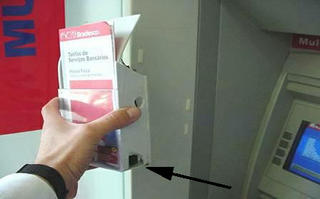
Picture of ATM skimming device using a hidden camera.

While North America was under attack in the Debit Card breach a few months ago, Britain rolled out Chip and PIN technology. At the time, the experts promised "Chip and PIN" cards would stop fraud dead in it's tracks.

Criminals are already beating this technology with skimming devices, which are mounted on ATM machines. AND it gets even scarier, the latest devices don't need cameras to record a PIN and can be built from parts ordered over the Internet.

Wikipedia already has an extensive section on Chip and PIN. I was amazed to discover that they were very up to date regarding potential security issues.

Chip and PIN is the name given to the initiative in the UK but countries worldwide are launching their own initiatives based on the EMV standard, which is a group effort between Europay, MasterCard and VISA. By the end of 2004, 100 countries will be using compatible systems based on this standard, and France aims to migrate its existing systems to be compatible with the new cards.

Sean Poulter of the Daily Mail reports on the recent Chip and PIN fraud:

Cloned cards belonging to Britons have been used to withdraw more than £1million in cash from machines in the UK, Paris, Sri Lanka, India and Hong Kong.

One card holder is believed to have lost as much as £25,000.

The police and banks have suggested that the problems at Shell petrol stations, which have centered on Surrey, emerged over the last eight weeks.

However, one Daily Mail reader from that area said his card details were cloned - he believes at a Shell outlet - in July last year.

Other readers believe their card details, including PINs, were stolen at garages operated by other companies, including BP and Esso. Cards have also been cloned at cash machines on at least one Total forecourt and at Tesco stores.

Full story, here.

Reading this, I had to reflect on the recent Debit Card breaches in North America. Early in the story, skimming devices were brought up a potential source. As the compromise spread across the continent, we heard rumors (still never confirmed) that retail systems were hacked. In the end, a few people were arrested and the story faded away.

Quite simply, it seems that the financial industry isn't commenting.

Whether the intention of not commenting is to protect the public, or the financial industry; it is clear that something needs to be done about this in the near term. Hopefully, the lack of information being released on these cases is because a strong investigative effort is underway.

It will be interesting to see what information is released on this latest case and how many more victims this latest caper will claim.

Here is a previous post, I did on the Debit Card breach:

Debit Card Breaches, A Growing Problem