Showing posts with label SIRAS. Show all posts

Monday, December 10, 2007

SIRAS offers guarantee that it will reduce retail crime

The reason SIRAS' product registration and smart return service perked my interest is because it protects people's privacy and is an effective means of reducing losses.

SIRAS tracks an inanimate object (merchandise) instead of a customer's personal information.

Now they are now offering a "guarantee" the technology will add dollars to a organization's bottom line by reducing fraudulent returns.

In their own words from the press release regarding this matter:

Electronic Product Registration, is putting its money where its mouth is with a unique Return On Investment (ROI) Guarantee for any company using SIRAS’s product registration and Smart Return service to manage their product returns and warrantees. The program, designed to eliminate any risk for companies interested in implementing SIRAS’s technology, guarantees that over the course of a year companies will save more money through deflected product returns than it spends in transaction fees.

In case you haven't had to refund any merchandise in a long time, most retailers require you to give them your personal statistics before they approve your return.

This information is all maintained in a database, where it might be exposed to a hacker, or probably more frequently, dishonest employee. Information is worth a lot of money to anyone, who knows where to sell it.

A dishonest Certegy employee recently got caught selling 8.5 million people's information to an undisclosed data-broker. Since the mysterious data-broker still hasn't been identified -- despite being listed as a co-conspirator in court filings -- we really aren't sure where these records went?

Certegy provides check verification services for a lot of merchants.

Personal and financial information is marketed in carder forums (chat rooms) on the Internet. Anonymous payment methods, such as wire transfers, PayPal and eGold add to the problem. They make it relatively easy to buy and sell stolen information.

It also isn't unknown for criminal organizations to plant, or recruit employees to steal information from within an organization.

The press release quotes Peter Junger (SIRAS CEO) as saying, "And in all cases, regardless of ROI, clients retain all of the valuable POS data collected."

This POS data also serves another important purpose. If the merchandise is found in a fencing operation, or on an auction site, it can still be tracked to the point-of-compromise.

This opens up opportunities to recover stolen merchandise and makes it more dangerous for the criminals fencing it.

Mesa Police Department tested these capabilities with SIRAS and FOX News did a story on it, which can be seen, here.

The technology, when deployed properly with a point-of-sale system can also identity fraudulent means of tender used to purchase merchandise.

SIRAS technology can be deployed by a merchant, or at the factory, itself.

They already makes their database available to law enforcement free-of-charge.

With all the identity theft and counterfeit ID available, using SIRAS reduces the possibility that an innocent customer will be wrongfully identified as an "undesirable" in a refund database.

Saying that, who knows how much of the information in these databases is one-hundred percent accurate anymore? With retail crime becoming more and more organized, the possibility exists that it is NOT.

One of the systems targeted in the TJX data-breach was their refund database. The information in this database is probably worth more than simple financial information because it contains the elements necessary to assume a person's identity.

It's relatively easy to shut down a bank account, or credit card number. Once a person's statistics are compromised, they can be at risk of identity theft for a long time.

Data breaches are becoming more expensive. TJX claimed a loss of $118 million in their second quarter earnings. Estimates vary widely on exactly how expensive data-breaches will become, but everyone agrees the cost of them is going up.

SIRAS seems more effective in resolving property crimes because it tracks the property, itself. It also protects customer privacy and protects a merchant from becoming the victim of a data-breach.

I doubt that SIRAS would make this guarantee if they weren't absolutely certain of the results. If they were wrong, I doubt they would be in business very long.

Press release from SIRAS, here.

Saturday, September 08, 2007

SIRAS PI - tracking theft to the source


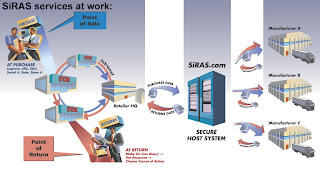
Graphic demonstration of anti-theft technology courtesy of SIRAS.com.

Criminals, who steal goods, whether with bogus financial instruments, or by more physical means might be in for a little surprise if the merchandise is protected by SIRAS PI.

Last week, SIRAS made this announcement in a press release:

SIRAS.com, the pioneer in Point-Of-Sale Electronic Product Registration used by leading manufacturers and retailers, has announced the nationwide launch of SIRAS P.I., a groundbreaking initiative to aid law enforcement officials in determining whether products they recover are, in fact, stolen, and if so, from where. Piloted by the Mesa, Arizona Police Department, SIRAS’s P.I. (Product Information) Database has already proven to be effective in helping law enforcement officials identify stolen items, report suspicious items, and apprehend and convict thieves. The database will be available, free of charge, to police and law enforcement agencies nationwide.

The way SIRAS works is simple, but effective. It tracks a product by recording the UPC (Universal Product Code) and the product serial number. SIRAS has the capability to determine where merchandise was stolen, whether from a merchant, manufacturer, or individual.

Earlier this year, SIRAS did some testing that revealed a substantial reduction in TV and MP3 player losses on products, where their technology was being used.

If deployed properly at the merchant level -- it could also determine how an item was purchased, and whether or not -- the method of payment used was legitimate. In theory, a merchant could also use the technology to impact credit card chargeback and fraud check losses.

I say "deployed properly" and "in theory" because the information to accomplish this (sales data) belongs to the company using SIRAS technology. Because of this, the capability to track sales information would have to be implemented inside the company. At most larger companies, this information is already tracked and analyzed to prevent and detect dishonest activity.

For years, most high-theft (shrink) merchandise has been secured so a thief can't merely pick it up from a shelf. When high-theft merchandise that was secured is stolen, it's normally because of one of two reasons. It was purchased with a bogus financial instrument, or an insider was involved in the theft.

Other reasons for secured merchandise being stolen might be a theft, directly from the manufacturer, or a theft during the shipping (transport) process. In these instances, if the merchandise was registered at the manufacturer, SIRAS can identify the point of compromise, also.

Technology has made it a lot easier for criminals to obtain and use fraudulent forms of payment. Information being compromised (data breaches) and anonymous places to communicate like Internet chat rooms, have given a lot of common criminals access to bogus financial instruments.

Along with the increased availability of fraudulent forms of payment, obtaining counterfeit identification documents has become fairly easy, and the identity used on them normally belongs to someone else. This has made it easy for a lot of retail criminals to operate as someone else.

Because of these new trends, current systems that record personal information to prevent fraud are becoming less effective than they use to be. I often wonder (no one probably really knows) how much of the information contained in them is incorrect.

In the recent data breach at TJX, one of the systems compromised was their refund database. Stories have circulated recently about the wrong people being pegged as frequent refunders, or bad check writers after their identities were stolen.

Neither one of these situations fosters good will, or trust with customers. Besides that, data breaches are becoming costly. The last I heard TJX has spent approximately $256 million dealing with the breach. With pending litigation, the cost is liable to keep going up.

With SIRAS, using personal information isn't necessary to determine, whether or not, a return is legitimate. SIRAS already has proven to be highly effective in reducing refund fraud without asking for one item of personal information.

An example of how some of the TJX data was used in a retail theft scenario can be seen, here.

Given that criminals that steal merchandise want to turn it into money, two methods are normally used. They either refund it somewhere, or fence it. Auction sites provide an easy and when combined with account-takeover activity (anonymous) venue for criminals to fence merchandise.

In the auction world, seller accounts are taken over all the time. This normally occurs when seller accounts are compromised by a phenomenon known as phishing. Phishing occurs when a person is tricked into giving up their access information after receiving a spam e-mail.

Compromised seller accounts are sold on the Internet the same way financial information is, and there is a trend in DIY (do-it-yourself) phishing kits being sold that enable non-technical criminals to get into the game.

eBay and PayPal are two of the most heavily phished brands. Once these accounts are compromised (taken over), they are used by criminals to fence merchandise and launder the monetary proceeds of their illicit sales.

Another growing trend related to phishing is when malware, also sometimes known as crimeware is used to steal information. The difference here is information is stolen from systems automatically (normally by keylogging software) and social engineering (trickery) is no longer necessary to get people to give up information.

Malware is often picked up by a computer system by clicking on a spam e-mail link, or by visiting a website designed to inject the software on a system. PC World recently did one of the many stories floating around about malware being sold on the Internet in the form of DIY kits.

In the story they wrote:

The global market for criminal malware now operates like a supermarket, complete with special offers and volume discounts, a security company has discovered.

Here again, this capability enables not very technically inclined criminals to get into the game. This has become a growing problem and I expect it to get worse before it gets better.

With the availability of all this personal and financial information, being sold on an economy of scale, current fraud protection systems are routinely being compromised by a lot of criminals.

There is an old saying in the investigations world, which is if you want to solve a crime, the easiest way is to follow the money.

SIRAS takes this one step further by tracking both the merchandise and can track the money ( if programmed to do so by the user). When you do this, the odds are far greater that the true culprit will be identified. They are normally associated with either the money, and or the merchandise.

Since the technology records both physical and UPC information, the database can determine exactly where the merchandise was compromised (stolen). Given that many merchants use digital video systems -- which are capable of storing video footage for a long time, it's also possible to obtain video evidence of the original transaction -- when sales information has been programmed to tie into the technology.

SIRAS has been used by select manufacturers and merchants for several years now -- however a new initiative, SIRAS PI, which was tested with Mesa PD -- makes the database available to law enforcement agencies free of charge.

Law enforcement can access the database either via the Internet, or by telephone. They can also add items to the database when they are reported stolen. If someone later tries to refund the merchandise at a participating retailer, the transaction can be automatically flagged.

Although a lot of fencing now occurs on the Internet, the technology is equally as effective in investigating more traditional property crimes, also. The bottom line is once merchandise is discovered, it can be tracked by SIRAS, if the item has been registered.

Recently, Chris Hansen (MSNBC), did a story about iPod theft. When Apple was approached about tracking the merchandise using Apple's registration database, they decided not to cooperate with MSNBC.

Undaunted by this, MSNBC purchased a bunch of iPods and engineered the registration disc to send them the information when the iPod was registered. They then left the iPods (new in the box) unattended, let them get stolen and tracked them to the crooks once the iPod was registered.

Chris Hansen made an excellent point on how databases can track stolen merchandise -- but in this instance, brand new iPods had to be left in public places to be stolen -- then registered to make the point.

If Apple used SIRAS technology to protect their merchandise -- it would have already been traceable, even if it was stolen from an individual -- who didn't provide the thief with the registration disc. It also would eliminate privacy concerns, which might be why Apple didn't want to cooperate with the MSNBC investigation?

When registering any product, a lot of personal information is normally asked for.

In any event, most criminals of the smarter variety aren't going to provide their personal information in the registration process. Most of them shy away from doing things, which might get them caught.

It would be interesting to have MSNBC, or another investigative news source do the same story with merchandise protected by SIRAS. The story might expose more than people, who stole because of an almost "too good to be true" opportunity was provided to them.

MSNBC iJacking story, here.

This brings up another potential benefit to this technology. Expensive portable electronics and other expensive toys like mountain bikes are stolen from the people who buy them (customers) all the time. Using SIRAS technology might even be a selling point that instills customer trust in the product they are purchasing.

This technology has prevention/investigation applications for corporations, law enforcement agencies and individuals, alike. It also doesn't require using people's personal information, which isn't as effective as it used to be, and is becoming more unpopular all the time.

In my opinion, this technology has the ability to make it a lot harder to get away with stealing merchandise and converting it into money.

Of course, the more it is used, the more effective it will become. Databases have a tendency to do this, or become more useful as they contain more information.

There are a lot of anti-theft/fraud technologies that claim to prevent theft/fraud. Very few of them also claim to be able to go after and hold the criminals committing the fraud/theft personally accountable.

The last I heard, most criminals still fear getting caught!

If you would like more information on the organized trade in counterfeit identification documents, the story of Suad Leija can be seen, here.

Suad's story has been covered extensively in the media, including by Lou Dobbs. Currently, she is writing a book and I keep in touch with her occasionally.

More information about bogus financial instruments can be seen, here and here.

A chronology of data breaches is compiled by the Privacy Rights Clearinghouse, here.

The best source on phishing is the Anti-Phishing Working Group and if you are interested in learning even more about phishing and want to see some totally fake banking sites, Artists Against 419 is another good place to visit.

Last, but not least, if you are interested in learning more about SIRAS PI, you can do so by visiting their site, here.

Friday, April 06, 2007

Former IRS employee charged with a different type of refund fraud

With the deadline to file our taxes almost upon us, the term refund fraud, normally is associated with filing a fraudulent tax refund. A former IRS employee, Robert Dooley has been charged a different type of refund fraud (retail). The stated losses in this case were $330,000.

Dooley allegedly stole merchandise and refunded it in nine states (he gets around), using his IRS identification to intimidate (my best guess) Home Depot employees.

Many retailers allow returns without a receipt if identification is presented. The practice of maintaining this information in data bases, which might be hacked has been a concern with privacy advocates, recently.

I examined this issue in a recent post on what some retailers are doing to protect themselves without data mining information (SIRAS technology), here.

Refund fraud is estimated to cost retailers $16 billion a year based on a study conducted by Dr. Richard Hollinger at the University of Florida.

In many instances, Dooley received gift cards, which retail crooks often turn into cash, using a variety of methods.

Reuters story on this matter, here.

Their article suggests that Dooley would pick up the merchandise and head directly to the return counter. This is a common way retail criminals perform a fraudulent refund.

This isn't the first time in recent history a civil service type was involved in this activity. A little over a year ago, I did a post on a former Bush advisor doing fraudulent refunds:

Former Bush Advisor Arrested on Shoplifting Allegations

And civil servants aren't the only public figures that have been caught shoplifting.


(Winona Ryder photo courtesy of Wikipedia)

Thursday, March 22, 2007

SIRAS – Smart technology that protects profit and privacy


Organized retail crime, according to RILA (Retail Industry Leaders Association), is a $34 billion a year problem. A study at the University of Florida conducted by Dr. Richard Hollinger suggests that 9 percent of all refund activity or $16 billion is fraudulent.

At most merchants today, refunds are tracked with personal information. While this was effective 10 years ago, the information in the current databases might not be as accurate as it once was.

Personal and financial information is stolen and sold in a lot of places, most notably over the Internet. A perfect example is the recent compromise of consumer data at TJX stores. This information is turned into fraudulent identification and financial instruments and sold to criminals.

It is likely that criminals can assume multiple identities, using other people’s information to refund merchandise. In fact, payment (credit/debit) card and bad check fraudsters already demonstrate this ability on a daily basis.

With the negative publicity surrounding data breaches and identity theft, honest customers are nervous when asked to surrender their personal details. Recently, privacy groups and Senator Chuck Schumer have been openly critical of current systems, which gather personal information.
A company named SIRAS provides a means to protect an organization’s bottom line and their customer information, also. The way they do it is so simple, it’s brilliant. Instead of tracking personal information, SIRAS tracks the merchandise, itself.

The SIRAS system captures the UPC and serial number of a product at the point-of-sale and creates an electronic receipt. This enables a merchant to determine exactly when and where it was sold AND how it was paid for.

SIRAS can tell when the merchandise was never purchased (stolen), or if it was purchased at another retailer. It also can identify counterfeit merchandise, price switching and altered/counterfeit receipts. Because it ties into a sales transaction, the system could also identify fraudulent forms of payment used to purchase the merchandise, or if the item has been a chargeback issue.

SIRAS makes it pretty hard do a fraudulent refund. Getting series of numbers to match can be extremely difficult, if not almost, impossible.

The data is compiled into customized reporting tools, which can be leveraged to determine risk factors when merchandising products. These tools also have extremely useful applications from an intelligence (analysis) and investigation perspective.

Besides organized retail crime, the largest losses suffered by merchants are caused by internal theft. Fraudulent refunds, “sweetheart returns,” enable dishonest employees to steal cash, or issue credit to payment cards. Like their external counterpart, internal criminals now have to use personal information to prompt a point-of-sale system to issue a refund. Again, this information (which might not be accurate) corrupts a lot of the current databases.

Dishonest employees are going to have a hard time being able to match UPC/serial number to a legitimate sale. This will prevent employees from attempting to commit refund fraud, and should they decide to do so, the custom reporting tools (when used properly) would identify the culprits, with ease.

SIRAS can track and identify retail theft a long way past the refund counter. With its unique ability to track merchandise to a sale, SIRAS can be used to identify merchandise sold in fencing operations (and more likely) via Internet auctions.

In fact, SIRAS has been used to help prove criminal cases, or to obtain search warrants by law enforcement.

The system can also be used to identify counterfeit goods, wherever they might be appear for sale.

Other benefits include being able to better manager warranty programs and in the case of call centers (crucial in e-commerce), it provides their employees with direct access to the original purchase information.

An effective merchandising application, I noted was the ability (via analysis) to identify products that have a high rate of being defect rate, or that aren’t as easy to use, as advertised.

SIRAS has applications that go far beyond fraud at the refund counter.

The system is easily incorporated with patented technology into current point of sale systems and employee training is minimal. Being that it replaces many labor intensive tasks, payroll can be better spent in other areas.

SIRAS applications are beneficial not only to manufacturers and traditional retailers, but the system is equally effective in e-commerce applications.

This technology is already being used by several major retailers and manufacturers. You can view a list of them on their website (listed below).

With privacy becoming a bigger issue all the time, SIRAS provides a smart way to protect assets and not expose customer information. SIRAS makes it harder to commit fraud in a retail environment, while making it easier (customer friendly) to return an item without a paper receipt.

More information about SIRAS and who uses their services can be viewed at:
CNET's story about the TJX data breach can be viewed, here.