Showing posts sorted by date for query katrina. Sort by relevance Show all posts

Friday, October 26, 2007

As Southern California burns, watch out for charity scams!

A sad commentary on how some people react to a disaster are the amount of scams that surface as a result of them.

The Postal Inspectors are warning us that we are likely to see a lot of these scams appear as a result of the Southern California fires.

If you are one of the good people out there, who intends to lend some financial support, it is a wise thing to make sure your hard-earned money is going where it is supposed to.

From the USPIS release:

Our charitable nature leaves us vulnerable to charity fraud schemes. Most charities are legitimate organizations that support good causes. Some, however, are run by swindlers. With more than 700,000 federally recognized charities soliciting for charitable contributions, the U.S. Postal Inspection Service reminds everyone it pays to be cautious when making a donation.

Disasters bring out the best in people who truly desire to help those impacted by these situations. Unfortunately, disasters also bring out the worst; scammers take advantage of the circumstances by stealing the charitable donations intended to help victims of the disaster. Postal Inspectors saw numerous charity scams emerge in the days following the devastation of Hurricane Katrina, the 2004 Southeast Asia earthquake and tsunami, and the September 11th terrorist attacks.

The recent California firestorm offers a new opportunity for fraudsters to perpetrate charity scams. If you're considering a contribution to help with relief efforts, it's important to know where your donation dollars will go. California Charities can be researched on the Attorney Generalwebsite, http://ag.ca.gov/charities or at the Better Business Bureau's Wise Giving Alliance, http://www.give.org/.

The Postal Inspectors are also offering some general tips on how to avoid these scams:

-- Give donations to known charities, or research new or unfamiliar charities first.

-- Refuse high-pressure appeals. Legitimate fundraisers won't push you to give on the spot. -- Be suspicious of solicitors who say they can only accept a cash donation.

-- Always make checks out to the name of the charity, never to an individual.

-- Be wary of "sound-alike" charities, many scammers use names that sound similar to names of legitimate charities.

-- Be skeptical if someone thanks you for a pledge you don't remember making. This is a tactic scammers use to lull victims into sending "additional" funds.

-- Ask for ID. For-profit fundraisers must disclose the name of the charity requesting the donation --- it's the law. Many states require paid fundraisers to identify themselves as such and to name the charity for which they're soliciting. If the solicitor refuses to tell you, hang up and report it to law enforcement officials. Also ask how much of your donation goes to those in need and how much goes to the fund raiser.

Last, but not least -- if you spot one of these scammers, you can help terminate their activities by reporting them to the Postal Inspectors.

You can find your local Postal Inspector by calling 877-876-2455. If you are of a more technical nature and prefer to report illegal activity online, you may do so, by clicking here.

USPIS release, here.

Although, Arnold isn't taking calls from bloggers this morning, I'm sure he supports terminating this type of activity, also.


The people in Southern California will need a lot of money to help them recover. Wasting monetary resources on scams will not help the situation.

PS: I'm dedicating this post to Paul Young, a noted Southern California blogger and friend, who writes Prying1.

I've enjoyed reading his investigative insights on issues, which are obtained, by digging a little deeper than the mainstream media.

Sunday, July 29, 2007

The Coalition Against Domain Name Abuse seeks to disable Cybersquatting

Cybersquatting is where people, who may have less than honorable intentions, set up a website with a domain name that appears to be a trusted brand, or organization.

Often, these domains are then used to commit financial crimes on the Internet.

In most of the recent disasters, most notably the Katrina hurricane, some of these look alike domain names were sold for a lot of money.

Sadly, these look-alike domain names, which victimize people and businesses, are being sold legally.

These look alike domain names are used in phishing scams, also. If you ever want to see a lot of fake websites, that appear to be real, visit Artists Against 419 and go to their Lad Vampire page.

Dibya Sarkar of the Washington Post is reporting about a coalition lobbying Congress to stop making this activity (like most crime on the Internet) too easy to accomplish:

Well-known companies such as Dell Inc., Yahoo Inc. and Marriott International Inc. are lobbying Congress for tougher laws targeting online scammers who profit from their brand names.

United as the Coalition Against Domain Name Abuse, 10 companies have hired the law firm Alston and Bird LLP to persuade federal lawmakers of the need to crack down against those who claim Web addresses, or domain names, that include _ or even resemble _ a legitimate company's trademark.

Washington Post story, here.

The coalition has set up a website, that anyone can join:

The Coalition Against Domain Name Abuse

The Post article failed to mention all the businesses backing the coalition. The entire list is located, here.

Tuesday, July 17, 2007

A look into labor abuses in the aftermath of Hurricane Katrina


Photo courtesy of Ruffit at Flickr

It never ceases to amaze me that we keep seeing additional allegations of abuse, fraud and waste come to light as a result of the Katrina hurricane, and it's aftermath.

Brian Beutler of the Media Consortium (courtesy of AlterNet) wrote a pretty telling article of the abuses dealt to laborers, who went to New Orleans to assist in the reconstruction/clean-up effort.

Brian reports:

In the two years since the disaster, there have been thousands of testimonials -- issued to both government officials and private advocates -- about a wide taxonomy of abuses.The most frequent complaint workers cite is withheld wages, but almost as numerous are accusations of employee intimidation, toxic and hazardous working conditions, immigrant abuse, trafficking, exploitation and monetary extortion.

Many workers, who went to New Orleans were paid a small percentage of what they were promised:

On December 30, 2005, Wilson received $865 in pay for the 94 hours of work he did from November 20, through Dec 7. For a similar stretch between January 5 and January 18, he was paid only $206.10. In each case, he should have been paid about $1,500.

According to the article, the Bush Administration suspended affirmative action and documentation requirements for immigrant workers. They also removed the requirement to pay "prevailing wages."

The end result of this was that visiting American citizens and local residents were underbid by foreign workers, who probably weren't legal. Of course, no one can say this for sure because it wasn't checked out (very well) at the time. However if this wasn't the case why did Senator Mary Landrieu (Democrat LA)request that ICE agents be dispatched to look into the problem?

This resulted in even more people doing a dirty job not getting paid:

The result was astounding. On payday, subcontractors, faced with undocumented workers seeking cash, often called ICE to report their own operations, causing frightened workers to either scatter or face deportation to their home countries without pay.

Likewise, employee recruiters, dispatched by subcontractors to foreign countries, would offer often-destitute men and women the promise of good work and fair wages at any number of reconstruction jobs in New Orleans.
Congressman Dennis Kucinich held hearings into this to determine, whether or not the Department of Labor (DOL), did their job in controlling some of this abuse.

Many believe, they did not.

For those, who like me continue to be fascinated by the social issues in the Katrina disaster, Brian's full article can be read, here.

My personal opinion is that they need to be studied, carefully. A lot of citizens (and apparently non citizens) suffered, not because of a lack of resources, but because of what appears to be a "few greedy people."

I've written quite a bit about Katrina (in my own personal study of what went wrong). My previous posts can be read, here.

Another great place to learn more about the social issues surrounding Katrina is Margaret Saizan's Beyond Katrina.

Wednesday, May 02, 2007

Washington Post exposes another reason why Katrina victims are still suffering

The hurricane disasters, and their commentary on social issues, continue to amaze me. To me, the rest of the world can learn a lot by studying the ongoing problems related to the disaster.

The amount of money wasted, or lost to fraud (over a billion and growing) is a sad commentary, when a lot of the victims are still living in the now (infamous) FEMA trailers.

Now a new allegation is being brought forth, which is that $854 million in aid promised by our allies, wasn't even accepted. I find this pretty interesting as people are suffering nearly two years, afterwards?

Even more shameful was that expert search and rescue personnel, were turned down, immediately after the hurricane, when they probably would have been extremely helpful:

And while television sets worldwide showed images of New Orleans residents begging to be rescued from rooftops as floodwaters rose, U.S. officials turned down countless offers of allied troops and search-and-rescue teams. The most common responses: "sent letter of thanks" and "will keep offer on hand," the new documents show.

This fact, given the problems in the initial response, amazes me.

Original Washington Post article, here.

I wonder how our allies, many of who have accepted similar aid from us in the past, felt when we turned their generous offers down?

More recently, the Post is reporting that Congress intends to look into this. The article regarding this can be read, here.

I'm not sure when the story on Katrina will be over. The bottom line is that there are still a lot of hurricane victims, who could use a helping hand. A good place to learn more about this is Margaret Saizan's site (Beyond Katrina), which can be seen, here.

Wednesday, April 25, 2007

FEMA declares they are becoming stronger after realizing how much money was wasted in the hurricane disasters!

Hope Yen at the AP has written an article based on a report by the Inspector General at Homeland Security that $3.6 billion in contracts were awarded to companies with ties to the Republican Party rather than to local companies, impacted by the Katrina/Rita hurricanes.

She quotes Senator Dorgan, who requested the audit, as saying:

"This confirms what we already knew about FEMA — there was a staggering level of incompetence, and the victims of Katrina, as well as taxpayers, are taking it on the chin," Sen. Byron Dorgan (news, bio, voting record), D-N.D., who requested the audit, said Monday.

Dorgan, who chairs the Democratic Policy Committee, said that it was ironic that the new contracts were aimed at helping small businesses in the region get back on their
feet, but instead "some very big interests got some very lucrative contracts."

"There are a lot of things wrong with this, so this report should be a warning signal to Homeland Security and FEMA," he said.


Government investigators already estimate over $1 billion in losses due to waste.

FEMA's response was:
In response, FEMA in the report disagreed that the wide price variations put taxpayers at risk. The agency contended that it was comfortable with bidders' financial viability based in part on past performance. In cases where contract prices appeared unreasonably high, those would be offset with lower payments later on subsequent work orders, FEMA officials said.

FEMA spokesman Aaron Walker said Monday that the agency welcomed the audit's findings and was working hard on improvements to better perform its duties "while being a conscientious steward of taxpayer dollars." He said that FEMA contracting officers did a "remarkable job" given their short time frame.

The audit will assist in making "the new FEMA stronger, more flexible and cost-effective," Walker said in a statement.

Full AP story with links to the Homeland Security report, here.

Both sides can argue, but one thing is apparent, which is we probably could have done a lot more for the victims with the resources we spent!

If mistakes like this ($1 billion and counting) were made at a private organization, do you think the people making them would still be employed?

Probably, not very likely! Perhaps, I could get "the Donald" to comment, but that's not very likely, either.

The political climate on wasted government money is heating up. Recently, I blogged about $2 billion, allegedly wasted by a company (recently sold off by Halliburton) called KBR:

The case of an alleged $2 billion government contract fraud/abuse in Iraq/Afghanistan

In this case, it appears that we could have better served those, who are serving US!

Saturday, April 21, 2007

How much of our Social Security money is benefiting former illegal aliens in Mexico?

With predictions that Social Security might be bankrupt before many of us ever receive any benefits, money potentially being given to people not entitled to it, bothers some people.

Dr. Jerome R. Corsi (WorldNetDaily.com) just did a very eye-opening analysis of the problem, where he states:

Amid the U.S. government's acknowledgment of rampant document and benefit fraud, the Federal Reserve is wiring 26,000 Social Security payments every month to Mexicans south of the border.

Officials with the Federal Reserve and Social Security Administration insist payments are not going to illegal aliens but admit they cannot be certain. Meanwhile, the Department of Homeland Security has launched a new task force to address the "growing" problem of benefit fraud, including in the Social Security Administration.

I like the official statement that no payments are going to illegal aliens, but they can't be certain?It seems to me that if they were certain, they might HAVE do SOMETHING about it.

I sometimes like to examine the money trail, which is what anyone wanting to determine fraud should follow, and according to the article:

According to the Federal Reserve, in 2005 the amount of funds transferred to Mexico reached more than $30 billion, up from $16.6 billion in 2004. The remittance market to Mexico has experienced double-digit growth in recent years.

Even scarier, was what is termed a totalization agreement with Mexico, that Social Security refused to release until forced to by an advocate group for senior citizens:

As WND previously reported, after refusing to release the document for three and a half years, the Social Security Administration in January finally made public a totalization agreement that "would allow millions of illegal Mexican workers to draw billions of dollars from the U.S. Social Security Trust Fund."

The disclosure was forced by a Freedom of Information Act request filed by the TREA Senior Citizens League, a non-partisan seniors advocacy group.

This hasn't been signed into effect by President Bush, but it could be done without congressional approval.

Dr. Corsi sums up this analysis using factual data from the GAO:

In September 2003, the U.S. General Accounting Office estimated a Social Security totalization agreement with Mexico would cost $78 million in the first year and would grow to $650 billion (in constant 2002 dollars) in 2050.

The GAO admitted even this estimate was low given that the totalization agreement provides an additional incentive for millions more Mexicans to enter and work in the United States.

Dr. Corsi's highly interesting analysis (I highly recommend reading the entire article), here.

So far as the officials, who aren't certain if fraud is occurring, they might want to consider the amount of benefits fraud, recently uncovered in the Katrina and Rita hurricanes. Initially, officials seemed to be in denial (not certain) about how much of it happened there, also. After the GAO did a little digging, they seemed to find quite a bit of it - and rumor has it - they aren't finished finding all of it.

Benefit fraud is a huge problem, and it costs us all in the form of higher taxes. It also takes away from the funds available to pay honest people, who are entitled to receive them.

Here is another post, I wrote about the scope of this problem in a limited area (Southern California):

Los Angeles Grand Jury Calls Child Care Program an ATM for Thieves

The official ICE press release about the government task force looking into this problem can be seen, here.

Friday, April 20, 2007

While a nation mourns, cyber criminals are on the attack

Earlier in the week, I blogged about how cyber criminals (ghouls) would likely use the Virginia Tech disaster to line their pockets.

According to Jeremy Kirk, IDG News Service, this prediction is becoming true -- and according to experts -- fake domains are being set up at a faster rate than after the Katrina hurricane.

Even malicious software a.k.a (crimeware) is being circulated via spam e-mails, claiming to have a link to cam phone footage of the incident.

Clicking on this filth can turn your computer into a zombie (normally used in a botnet to send more spam) -- or even log your personal and financial details -- which might be later sold in a carder forum (used for identity theft).

Very interesting and sad commentary on how cyber criminals are on the attack, while a lot of people are in mourning, here.

One place, I recommend to send any of this (trash) you spot on this is to Castlecop's:

Phishing Incident Reporting and Termination Squad (PIRT)

They make sure this garbage gets reported to all the appropriate parties!

Wednesday, April 18, 2007

Are Charity Fraudsters (Phishermen and Pharmers) preparing to exploit the Virginia Tech Disaster?

Internet criminals use disasters to get nice people to donate their hard-earned money to them, personally. Recent examples where this occurred have been the Katrina hurricane, Tsunami disaster and London bombings.

According to the Sans Internet Storm Center, we can probably expect the same activity to occur in the wake of the Virginia Tech Disaster.

Here is what they are reporting in their Handler's Diary:
There has been a flurry of domain registrations related to the Virginia Tech tragedy, as reported by GoDaddy and other registrars. While some of these are undoubtedly well-intentioned organizations joining in the outpouring of support for the friends and family of the victims, others are likely to be opportunists who want to cash in on the suffering of others.

Be on the lookout for a rash of spam & phishing coming from these leeches. If you receive a plea for donations, check the organization out closely before opening up your e-gold, Paypal, Visa or other account or providing any personal information. In some cases the phishers may use voice, fax, email and websites to dupe generous and thoughtful victims into disclosing valuable information.
Full diary post (with potential domains being grabbed), here.

As the SANS post aptly points out, giving out any personal, or financial information to one of these fraudsters (leeches) can have more consequences than giving your money away to the wrong place (identity theft).

Here are some investigative (due diligence) resources someone might take advantage of to make sure they are donating their money to a worthy cause:

Better Business Bureau Wise Giving Alliance

Charity Navigator

American Institute for Philanthropy

The Federal Trade Commission (FTC) has some information on how to make sure your money goes to the cause you intend it for, here. Also contained on this page is where you can report fraudulent activity to them, which is highly recommended.

Tuesday, March 13, 2007

Civil Servants under scrutiny for credit card abuses

Senator Grassley (Iowa) is introducing legislation to counter what he calls massive abuse with government credit cards.

He is quoted on his site as saying:
Every time we open these GAO reports we find more outrageous spending. Internet gambling and a Yankees baseball game don’t seem to be appropriate uses of tax payer money. The federal agencies don’t seem to be stepping up, so our legislation helps put some common sense controls on these credit cards.

The press release covers this in more detail:

Grassley said the legislation would also stipulate that cases of fraud be referred to the U.S. Attorney for prosecution and employees that egregiously misuse or commit fraud with a government charge card be fired. The bill would also increase oversight by providing that each agency Inspector General periodically conduct risk assessments and audits to identify fraud and improper use of credit cards.

Following the devastation of Hurricane Katrina, Grassley was concerned that provision raising the limit for emergency "micro-purchases" on government credit cards from $15,000 to $250,000 was ripe for waste, fraud and abuse and successfully fought to bring the limit back down. At the time, Grassley said that wasting taxpayer money does not help the victims of Hurricane Katrina.
Does this mean that government employees can commit fraud and waste taxpayer money without being fired, or prosecuted? If this happened in the private sector, the culprits would likely be fired and (possibly) prosecuted.

The sad thing is that Senator Grassley has attempted to introduce this legislation in the last two Congresses and it was never acted upon.

So far wasted taxpayer money not helping the Katrina victims, the GAO confirmed Senator Grassley's prediction. Here is a previous post on that matter:

More Allegations of Money Wasted in Katrina

Senator Grassley's press release on this matter, here.

Of note, Senators Norm Coleman of Minn., Joe Lieberman of Connecticut, and Susan Collins of Maine are supporting Senator Grassley in this legislation. Congressman Joe Wilson has filed similar legislation in the House of Representatives on government credit card abuse.

Civil servants should be held to at least the same standard as the people they are serving!

Sunday, March 04, 2007

Should recent prosecutions for fraud in Katrina remind us of something?

Bruce Alpert, of the Times Picayune did an excellent article about a lot of recent prosecutions for fraud in the aftermath of the hurricane disasters.

One woman, LaWanda Williams collected $267,377.15 in an identity theft scheme using several other people's information.

I wonder if any of the people (who had their information stolen) were denied benefits, as a result of LaWanda's activities?

And LaWanda is just one example of people's greed. FEMA and Army Corps of Engineers officials, Red Cross employees and many others took advantage of the situation.

In fact, fraud was being committed as far away as California, where 71 cases have been documented.

Bruce Alpert's article, here.

Bruce's article points out that this isn't the first time fraud occurred after a disaster. Similar fraudulent claims occurred after 9-11 and the Tsunami disaster.

The money lost to fraud is a symptom of the larger problem, which was a disaster preparedness system that failed. The resulting confusion enabled a lot of fraud to occur, and probably made it too easy to commit.

I doubt any of the people now being prosecuted thought they were going to be caught.

As the old saying goes - "an ounce of prevention is worth a pound of cure." Our focus needs to be towards preventing this from happening again.

If you would like to learn more about the hurricane disaster - and how how people are still being "cured" two years after the fact - Beyond Katrina has a lot of information on the subject.

Sunday, February 11, 2007

Blaming FEMA for the fraud in Katrina isn't going to solve the problem

There is no doubt about it - the Katrina and Rita debacle - was NOT a shining moment in our nation's history. Fifteen months later as New Orleans prepares to celebrate "Fat Tuesday" (Mardi Gras), more allegations of fraud and mismanagement are coming to light.

Two reporters (Michelle Roberts and Frank Bass) of the AP wrote an interesting article about how FEMA now wants $300 million back in claims paid for households that didn't exist, according to official pre-hurricane census figures.

Even more interesting is that they did their own analysis using the federal Freedom of Information Act, which deducts that a lot more than $300 million might come out in the wash before all is said and done.

Here is what they said in their article:
But an Associated Press analysis of government data obtained under the federal Freedom of Information Act suggests the government might not have been careful enough with its checkbook as it gave out nearly $5.3 billion in aid to storm victims. The analysis found the government regularly gave money to more homes in some neighborhoods than the number of homes that actually existed.

The pattern was repeated in nearly 100 neighborhoods damaged by the hurricanes. At least 162,750 homes that didn't exist before the storms may have received a total of more than $1 billion in improper or illegal payments, the AP found.

Full story (ABC news version), here.

While there is no doubt a big problem exists, we need to put the overall issues in perspective and I'm not sure FEMA is entirely to blame.

David Garratt, FEMA's deputy director is saying that officials were in a "no win" situation. And while, I'm not here to defend FEMA, he probably has a valid point.

When the federal government got involved, fraud artists from all over the world were setting their sights on what they saw as a "lucrative opportunity."

A lot of the fraud that occurred didn't necessarily come from the areas affected by the hurricane.

Couple this, with a lot of pressure to right all the initial blunders in the disaster, which most of us were watching "live," and mistakes were made.

Sadly enough, fraud prevention systems in place, were deemed to cumbersome and disabled. Again, there was a lot of pressure (rightfully so) to take swift action to help a lot of people, who were in harm's way.

We can blame FEMA all we want, but the fact is that fraud is growing at a rapid rate, and the federal government isn't the only one with inadequate fraud prevention systems.

For example, in Southern California (pretty far from Louisiana), there was another interesting article about the taxpayers footing a $1.5 billion a year bill for fraud, here.

And while there seems to be a lot of government fraud, fraud in the private sector is growing by leaps and bounds, also. There is no doubt that identity theft (another growing problem) helped fuel the fraud in the hurricane disasters.

There is a lot of evidence to suggest that much of this fraud is enabled by information that has been data-mined on all of us, which isn't protected very well. Some suggest that technology and the information sector, which make a lot of money selling their wares are the root cause of all of this.

Unfortunately, those committing fraud are too keenly aware of this.

Blaming FEMA is unlikely to correct the overall problem. And if their fraud prevention systems were inadequate, perhaps we should be looking at who sold them the faulty systems?

Perhaps, when history is written, the Katrina disaster is a warning of the looming disaster we all face if we don't stop viewing fraud as a "victimless crime."

Fifteen months later (as Mari Gras approaches), there are still a lot of people suffering from the hurricane disasters.

If you would like to learn more about this, Margaret Saizan's site (Beyond Katrina) is a great resource.

I wonder how much good the money would have done for the true victims if it hadn't been stolen from underneath them?

Saturday, December 30, 2006

The Road Home for Katrina Victims is Frustrating

With all the allegations of "poorly spent money" in the hurricane disasters, it's become apparent that a lot of money hasn't reached the people, who need it.

For instance, take the "Road Home Program", which has paid a company called ICF International over $60 million to issue $4 million in checks. The program is intended to assist victims in getting back into "livable housing," and will manage the distribution of $7.5 billion in federal relief money.

ICF International is a "consulting firm" based in Fairfax, Virginia. According to Wikipeida, it's services have been used by the U.S. Environmental Protection Agency, the Department of Homeland Security, the Department of Energy, the United States Postal Service, and Housing and Urban Development.

The program has it's own website, which states:
The Road Home program was created by Governor Blanco, the Louisiana Recovery Authority, and the Office of Community Development. The program is funded by the U.S. Department of Housing and Urban Development.
There has been a lot of criticism that ICF has been slow to fill positions for the project. Interestingly enough, there are a lot of positions (still not filled) advertised on their website.

The Times Picayune did an excellent assessment of the lack of program staffing, here.

The "Road Home" website also states that it dispels a lot of myths about the program, but it appears not everyone is "buying their version" of what is going on.

Because of the allegations of "mismanagement," the Louisiana House and Senate have passed two resolutions to terminate ICF's $756 million contract. They are also calling for an investigation into "possible conflicts of interest."

The Times Picayune reported:

The House and Senate, in separate unanimous votes, also passed House Concurrent Resolution 34 by Rep. Cedric Richmond, D-New Orleans, ordering a special legislative panel of New Orleans lawmakers and the Louisiana Recovery Authority -- the state agency overseeing recovery operation in the state -- to investigate ICF's handling of the contract. It was amended by Rep. Jim Tucker, R-Algiers, to also urge the federal Securities and Exchange Commission to probe ICF's public stock offering, shortly after winning the state contract, for possible conflicts of interest.

The Times Picayune article, here.

Sue Sturgis, who writes for Facing South, has also written some interesting commentary on the program.

Ms. Sturgis points out that ICF initially was involved in a contract to help the state decide how to spend federal grant money, which conceptualized the "Road Home Program." During this time frame, ICF decided to seek the "lucrative program administration project."

When the Louisiana Board of Ethics raised concerns that this contract might be perceived as giving ICF an unfair advantage in getting the larger contract, ICF ended the initial one. The payout for the first contract was $900,000, while the Road Home Program could pay ICF up to $756 million.

She also brings out other concerns the Board had with some of the banking relationships that were being proposed by ICF to administer the funds.

Facing South article, here.

Whether conflicts of interest exist remains to be seen. What can be clearly seen is that taxpayer money intended to help Katrina victims isn't getting to those who need it very quickly.

Red tape and excuses aren't going to be acceptable when there are a lot of people still living in "not very nice" conditions.

And until this matter is rectified, there are going to be "voices" calling for some "accountability."

Some of these voices are getting pretty loud.

This month, federal investigators plan to release audit results on contracts given to "so called" politically connected firms in the Katrina crisis. Speculation has it that these audits are going to reveal additional concerns about how money was squandered in the Katrina aftermath.

Friday, December 29, 2006

Ask Eric if there is "Zero Liability" in Identity Theft

Sometimes to understand what an identity theft victim is faced with you need to hear about it from a person, who has actually experienced it.

We live in a world where our information is gathered, sold and not protected very well. Meanwhile, there seems to be an army of fraudsters compromising credit issuers, who issue credit without checking very carefully.

Then there is the advertising, which claims that their financial products have a "zero fraud liability."

The Boston Globe did an interesting story that shows the liability innocent people face when they become identity theft victims.

Beth Healey writes:

Eric W. Carroll's credit report says he has a home in Florida, a wife named Katrina, and a pile of unpaid bills.

He first learned this when a debt collector called him in 2002, dialing his apartment in Bridgewater, yet asking for an Eric W. Carroll from Avon Park, Fla. Carroll insisted there was some mistake: He was not married, and he had never lived in Florida.

Nearly five years later, collectors are still hounding the wrong Eric Carroll.

Boston Globe story, here.

And even though Eric seems to have done all the right things, he seems to still be suffering.

There is no zero liability for identity fraud and we need to stop "sugar coating" the true impact it has on individual people.

Here are two places, I've recently "blogged" about where people can voice their opinion to people that can make a difference:

Tell it to the Identity Theft Task Force

Consumers Union Calls for Congress to Protect People's Personal Information

Tuesday, December 26, 2006

More Allegations of Money Wasted in Katrina

Recently, I blogged about - whether or not - we would ever discover how much money was wasted in the Katrina disaster. Unfortunately, this statement is turning out to be more accurate that I would have liked it to have been.

Hope Yen of the AP is reporting:

Federal investigators have already determined the Bush administration squandered $1 billion on fraudulent disaster aid to individuals after the 2005 storm. Now they are shifting their attention to the multimillion dollar contracts to politically connected firms that critics have long said are a prime area for abuse.

In January, investigators will release the first of several audits examining more than $12 billion in Katrina contracts. The charges range from political favoritism to limited opportunities for small and minority-owned firms, which initially got only 1.5 percent of the total work.
Government officals (past and present) are now alleging that the dollar amount wasted could exceed $2 billion.

AP story (courtesy of the Washington Post), here.

It will be interesting to see how this plays out and what evidence is brought to light as a result of this.

The sad truth is that there are still a lot of people suffering as a result of this disaster. And it doesn't make sense that they should be when this kind of money was available.

Here is a post, I wrote about the results of a recent GAO (Government Accountability Office) audit:

Will We Ever Discover the True Losses in the Katrina Disaster?

Tuesday, December 12, 2006

Will We Ever Discover the True Losses in the Katrina Disaster?

The Government Accountability Office (GAO) has issued another report stating that the fraud losses in Katrina and Rita are a lot higher than previously disclosed to the public.

The report states:
  • Almost $20 million in double payments was paid to people claiming damage to the same property in both hurricanes (Katrina and Rita).
  • Almost $17 million in improper or fraudulent "rental assistance" payments given to people already receiving free housing.
  • 500 foreign students received $3 million in aid.
  • $156,000 was given to foreign workers on temporary visas.

Sadly enough, the report indicates that FEMA disabled a system (edit check in NEMIS) that would have caught people using duplicate information (social security numbers) to make claims in both hurricanes. In five of the six cases examined, the claimants didn't even have to provide proof that they had conducted repairs after receiving money for the first claim.

I have no personal experience with "edit check in NEMIS," but computers run pretty fast in today's world, and it doesn't make sense to me that an entire system designed to detect fraud was disabled?

Didn't we have enough personnel to do a manual check when duplicate social security numbers were noted? And even if this were so - why didn't FEMA take action (themselves) to identify the issues before the GAO investigated?

The use of other people's social security numbers is nothing new and probably could have been anticipated, fairly easily.

There is also a lot of missing equipment. The report shows that 34 percent of the property purchased to aid efforts has either been lost, or stolen. In the case of 2o flat bottom boats purchased - only two remain missing - however twice the retail price was paid to a vendor, who also failed to pay for 11 of the boats he sold to the government.

Even scarier, the report indicates that FEMA overstated the amount of found property reported in July hearings to Congress. This was based on an e-mail sent by DHS (Department of Homeland Security) on the eve of the hearings.

FEMA's estimate of the monetary impact of fraud in Katrina was $290 million, however if one is to believe the GAO report, the real losses surpass $1 billion.

With the stories that surfaced about prison inmates making claims and stolen information (social security numbers) being used in claims for addresses that were vacant lots - it's entirely possible that there is additional fraud that hasn't, or never will be discovered.

There were also a lot of stories of charities being defrauded and even fake charities being set-up. The GAO report only addresses the fraud losses incurred by the government.

GAO report, here.

Report Fraud, Waste and Abuse to the GAO, here.

FraudNET (Report Fraud, Waste and Abuse)

One might come to the conclusion that we wasted a lot of money on Katrina, but this is far from being true. In fact, a lot of people are still suffering as a result of these disasters, and the truth is that the money could have been used for better purposes.

I plan to explore this more in detail in future posts, but for now, I'll pass on a site that is devoted to the real victims in these disasters:

Beyond Katrina: The Voice of Hurricane & Disaster Recovery

Friday, December 08, 2006

The Hurricane Disasters are a Sad Commentary on Society

During the Katrina and Rita disasters, I blogged frequently about what appeared to massive amounts of fraud going on. Reuters is now reporting that the dollar loss has topped 1 Billion dollars, here.

From government employees to fake charities, it appears a lot of people took advantage of those less fortunate than them in their "time of need."

And not very much of the money seems to have been recovered despite well publicized efforts.

Sadly enough, the public awareness of all the fraud is also likely to make it harder for victims in future disasters. The bottom line is that people - who take advantage of others in their time of need - should suffer severe consequences.

Perhaps, a lack of consequences (common in fraud schemes) is the reason this occurred? To prevent this from happening in the future, we need to make sure there are severe consequences for those committing the fraud, as well as, those who enable it by a lack of oversight.

After all, we were in a state of emergency, when these disasters occurred.

I'm afraid the amount of fraud we've seen come out of these disasters - which affected a lot of innocent people - is a sad commentary on our society as a whole.

Let's hope we do a little better next time.

To read my previous posts on this matter, link here.

Monday, October 30, 2006

B&B Owners on the Offensive Against Advance Fee (419) Artists

The advance fee artists on the Internet are always looking for a way to make a quick buck.

When they targeted B&B owners, they might have bitten off more than they can chew on.

Here is a warning from "Pillows and Pancakes" - a magazine covering the B&B industry:

The end goal is to get the B&B owner to send money to the scammer. Typically, the scammer will make a booking and overpay for it with either a credit card or forged check. The scammer will request the balance sent somewhere, usually by Western Union. Remember, these scammers are creative and there are many variations on the scam.
To read more on the different variations, link here.

They have listed other links to become aware and deal with this activity, also:

View Names/Aliases

Actions you can take

Resources

Forum

Unfortunately, I wasn't listed as a "resource," but here are some posts I've done on this type of Internet scam:

419 Artists Arrested and Tie to Funding Terrorists Suspected

Counterfeit Cashier's Checks Fuel Internet Crime

Counterfeit Postal Money Orders Showing Up in IScams Again

Aids Cure, Another Lure in the Internet Fraud Saga

Don't Trust a Bank to Tell You Whether a Check is Good, or Not

Advance Fee Scams with Katrina

And the most current bogus financial instrument a lot of these scammers are using is:

American Express Gift Cheques Being Circulated in Internet Scams

Please note that not even American Express has published anything on this yet - at least as far as I know?

Of course, the most extensive list of resources I've ever seen about Advance Fee (419) is the 419 Coalition Website.

On a closing note, I would like to welcome the B&B folks to this effort to rid the Internet of these "less than desirable" users!

Saturday, October 07, 2006

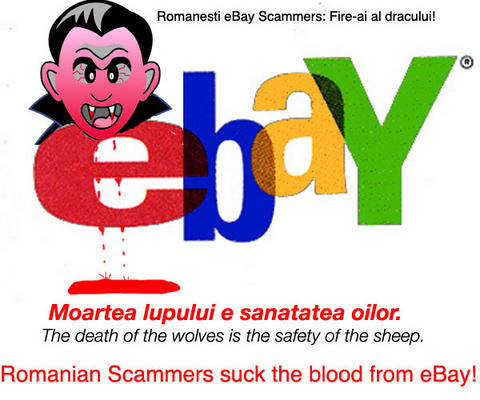
Auction Fraud and the Romanian Connection


(Interesting picture courtesy of Yahoo Group, eBay_scamkillers)

A lot of Internet crime seems to either come from Romania, or is tied into nationals from that country. Yesterday, I was reading about an arrest in the Los Angeles area, where two Romanians were indicted for auction fraud involving wire transfers and identity theft.

Courtesy of U.S. Newswire:

The indictment alleges that Manolache, Salageanu and others were involved in an Internet scam that defrauded victims across the United States by holding bogus auctions on eBay, Yahoo! Auctions and Autotrader.com. The conspirators posted items for sale that were never intended to be sold, then collected money from the "successful" bidders. The victims were instructed by the online sellers to send their payment by Western Union to circumvent online payment systems. Manolache and Salageanu then went to Western Union locations in the Los Angeles area and, using false identification, collected the victims' money. None of the victims received the items they had purchased.

As part of the scheme, the online sellers often masqueraded as Hurricane Katrina relief organizations.

Newswire story, here.

It seems that a lot of the intelligence used to go after Manolache and Salageanu was compiled by the Internet Crime Complaint Center (IC3). They have a page dedicated to this (Romanian) activity, which says:

Auction fraud is the most prevalent of Internet crimes associated with Romania. The subjects have saturated the Internet auctions and offer almost every in-demand product. The subjects have also become more flexible, allowing victims to send half the funds now, and the other half when the item arrives.

Internet Crime Complaint Center page, here.

And there are private individuals, who are fed up with auction fraud originating from Romania. Yahoo group, eBay_scamkillers is one such group comprised of volunteers that actively fight the Romanian scammers.

Here is what they say about their group:

Too many people are being rejected because they fail to properly identify themselves. If we even THINK you are a Romanian, you will be rejected. Take a moment to send a note to the group owner.

We share resources, baiting techniques and, of course... war stories! It's OK to lurk here, but why not join and help us SCAM THE SCAMMERS?

If you are a whiner, please do not join this group. There are plenty of eBay anti-scam forums where people can go to cry on each others' shoulders about their misfortunes.

WE ARE PRO-ACTIVE and WE ATTACK THE SCAMMERS ON MANY FRONTS. We use every available resource to fight back and we are VERY successful.

Link, here.

At first look, the site appears to be fairly inactive, but if you are accepted (after their screening process), they contact you.

Auction fraud is one of the biggest issues in the world of Internet crime. On an interesting side note, this recent indictment also highlights that not all auction fraud occurs on eBay. A lot of the complaints on these two Romanian nationals were from Autotrader.com and Yahoo! Auctions.

There has been a lot in the news lately about flocks of eBay users seeking "greener pastures." It will be interesting to see if "auction fraud" follows them.

Sunday, September 03, 2006

The FBI Will Pay for Information on Katrina Fraud

There is no doubt that there was a lot of fraud in the hurricane disasters a year ago. The Clarion Ledger (Mississippi) is reporting that the FBI will pay for information on Katrina related fraud:

Mississippi public corruption cases are on the rise in the wake of Hurricane Katrina, and the FBI will have 10 full-time agents investigating Katrina-related fraud by December.

Authorities are encouraging the public to come forward with tips and are offering cash rewards.

"If you see something, you hear something or learn something, even if you believe it's insignificant, if that little light goes on in the back of your head, that 'boy, this just doesn't look right,' don't be afraid to call," said John Raucci, the FBI's special agent in charge in Mississippi.

He said sometimes seemingly insignificant details can crack a federal case.

Cases of fraud are increasing in south Mississippi as billions of dollars in federal funds are authorized for the recovery effort. Raucci said publicizing the reward system is one way to help combat fraud.

"I myself can authorize up to $25,000 for any information," Raucci said. "That's just me out of my budget. I can go back to headquarters with one phone call and get $100,000. There are also other types of cases where you can actually get a percentage."

Full story, here.

I'm not sure if they are running a similar program in Louisiana. There are probably a few people who deserve to caught there, also.

Of course - there are also people - who report crime because it is the right thing to do. If everybody reported it for that reason - it would go a long way towards making our world a better place to live.

Friday, August 04, 2006

Fraud Steals from the Truly Needy

My blogging friend, Mr. T. L. Stanley, author of the New Rosemead Times wrote a post (Poverty Caused by Corruption) that made me do a little thinking.

Mr. Stanley writes:

"Fighting poverty seems to be hot ticket for politicians every time world leaders get together and want to show everyone they are in a giving mood. For some reason, America wants to throw money at worldwide poverty. Unfortunately, the money that is aimed at poverty is usually stolen by corrupt leaders of poor countries. Zimbabwean President Robert Mugabe is just one example of corruption. This president has driven a highly productive country into bankruptcy in 20 years. Because, political corruption is common. And, this president made the mistake of assuming that productive outputs would continue in the face of economic and political oppression."

For the full post (highly recommended) link, here.

Not only are we throwing good money at "not-so-good" countries, but we can see a lot of the problem, right here at home. Unfortunately, the Katrina hurricane and other allegations about "fraud and abuse" in programs intended to help the poor (a noble cause) help support Mr. Stanley's thoughts.

There is a lot of evidence showing that a substantial amount of the money intended to help the "poor," lines the coffers of corrupt individuals. Since the money never reaches the people it was intended for - corruption truly does cause poverty. Fighting poverty is a "noble cause," but it's also important to ensure that the resources are reaching the people that need it.

What is needed is a "zero-tolerance" approach to the people taking advantage of the poor.

If we did this - perhaps our social programs wouldn't be "going broke."