A lot of people are in dire financial straights because they got sucked into what is now being called the mortgage crisis.
Now that the problem is being examined carefully, a lot of fraud is being blamed as being a contributing factor to the entire mess. The problem is that the fraud aspect of the mortgage crisis is hardly over. Mortgage scams designed to take advantage of people in financial trouble are flooding the Internet and even the classified section of local newspapers.
Mortgage fraudsters for the most part don't have a conscience and could care less if they steal from your grandparents, neighbors or you!
The FBI, who has put more than a few of these people behind bars in recent history is using the intelligence gathered in their investigations to reach out to the public on how to avoid becoming conned with promises of a new beginning, or rescue from their current dilemna.
“And while some of these steps may require you to do a little extra work now in the long run it may save you aggravation, money, and even your house,” according to Special Agent Scott Broshears, a mortgage fraud supervisor with the FBI.
The first recommendation is to get referrals and then check out the licenses of real estate and mortgage professionals with government (state and local) regulatory agencies.
They also recommend that you do your own research on what homes have been sold for in your area. Checking out tax assessments is one way to do this.
Beware of too good to be true mortgage deals, especially using a no money down gimmick.
Never let anyone talk you into making a false statement on a mortgage application. This is how a lot of people ended up with mortgages they couldn't afford in the first place.
Don't sign a blank document or a document with blank lines. Something could be added later. Read everything thoroughly and if you don't understand everything completely get legal assistance.
Don't get conned into paying an upfront fee to get out of mortgage trouble. Be especially wary if these solicitations come from e-mail or web advertisements. You will likely be out the up-front fee and in the same boat as before you paid for the assistance.
In more sophisticated upfront (advance) fee schemes involving foreclosure fraud, victims are even talked into signing over their property. The victim loses the upfront fee, their house and still owes their mortgage when this occurs. Advance fee fraud has been around for centuries and is merely a false promise of something that is too good to be true in return for an advanced payment.
On a final note, the FBI recommends that if you are facing foreclosure, the best thing to do is to see if your lender will work for you.
Agent Broshears and the men and women working with him have seen their case-load with mortgage fraud triple in the recent past. By sharing these tips, learned from real life investigations, they hope to make their job easier and see a few less people victimized by this growing phenomenon.
If you need more information on mortgage fraud, the FBI has a page on their site dedicated to this subject.
Showing posts with label advance fee fraud. Show all posts
Showing posts with label advance fee fraud. Show all posts
Saturday, August 16, 2008


Monday, September 03, 2007
Educate yourself about scholarship scams before you go to school
With the high cost of an education these days, dishonest people are using the lure of a scholarship to cheat students and their parents of their hard earned money.
The FTC has a informative page on this trend:
More information on this from the FTC, here.
Also contained in the above link is information, where you can report suspected fraudulent activity to the FTC.
Advance fee schemes are nothing new in the world of fraud. If someone promises you something that's too good to be true and doesn't make sense, the best thing to do is ignore their offer and then report them.
The NACAC (National Association for College Admission Counseling) has put together a nice set of links regarding this subject, also.
The FTC has a informative page on this trend:
According to the Federal Trade Commission, unscrupulous companies guarantee or promise scholarships, grants or fantastic financial aid packages. Many use high pressure sales pitches at seminars where you're required to pay immediately or risk losing out on the "opportunity."
Some unscrupulous companies guarantee that they can get scholarships on behalf of students or award them "scholarships" in exchange for an advance fee. Most offer a "money back guarantee"- but attach conditions that make it impossible to get the refund. Others provide nothing for the student's advance fee - not even a list of potential sources; still others tell students they've been selected as "finalists" for awards that require an up-front fee. Sometimes, these companies ask for a student's checking account to "confirm eligibility," then debit the account without the student's consent. Other companies quote only a relatively small "monthly" or "weekly" fee and then ask for authorization to debit your checking account - for an undetermined length of time.
More information on this from the FTC, here.
Also contained in the above link is information, where you can report suspected fraudulent activity to the FTC.
Advance fee schemes are nothing new in the world of fraud. If someone promises you something that's too good to be true and doesn't make sense, the best thing to do is ignore their offer and then report them.
The NACAC (National Association for College Admission Counseling) has put together a nice set of links regarding this subject, also.
Monday, April 30, 2007
E Gold accused of being a money laundering vehicle for financial fraudsters and child pornographers
To anyone familiar with crime on the Internet, allegations of criminals using, or manipulating E Gold are nothing new. Like wire transfers, E-Gold gives their customers the ability to transfer the value of gold, electronically. To transfer the gold's value, all anyone needs is a e-mail address, account number and password.
Because of this, the accounts can be prone to phishing, and or crimeware (malware) attacks, using keylogging software. When this happens, the phishermen clean out the account and transfer it, elsewhere. E-Gold's terms of service stipulate that once a transfer is done, it cannot be reversed.
It should be noted that Internet criminals use wire transfer services (MoneyGram, Western Union) for the same reason -- they provide a lot of anonymity.
Apparently a task force from the Department of Justice has been looking into the money laundering angle, and is charging E Gold with several federal charges.
Here is a summary of the action against E Gold from the DOJ press release:
The basis of the DOJ charges are:
It appears a lot of different federal agencies worked on this investigation:
Full DOJ press release, here.
Besides allegedly being used to launder money, E Gold is often used in advance fee and auction scams, which trick people into sending their hard earned cash to fraudsters. I've written about the auction, secret shopper, romance, lottery and job variations of advance fee scams on this blog, frequently.
Like the problems with accounts being phished, or their value being drained because of crimeware, little can be done once the gold (converted to a monetary value) has been transferred.
When password details can be stolen, accounts can be taken over, also. This happens happens frequently on auction sites; when trusted accounts are compromised, then used for fraudulent purposes.
Wikipedia has an extensive article about Advance Fee (419), here.
It will be interesting to see how this plays out!
Because of this, the accounts can be prone to phishing, and or crimeware (malware) attacks, using keylogging software. When this happens, the phishermen clean out the account and transfer it, elsewhere. E-Gold's terms of service stipulate that once a transfer is done, it cannot be reversed.
It should be noted that Internet criminals use wire transfer services (MoneyGram, Western Union) for the same reason -- they provide a lot of anonymity.
Apparently a task force from the Department of Justice has been looking into the money laundering angle, and is charging E Gold with several federal charges.
Here is a summary of the action against E Gold from the DOJ press release:
A federal grand jury in Washington, D.C. has indicted two companies operating a digital currency business and their owners on charges of money laundering, conspiracy, and operating an unlicensed money transmitting business, Assistant Attorney General Alice S. Fisher of the Criminal Division and U.S. Attorney for the District of Columbia Jeffrey A. Taylor announced today.
The basis of the DOJ charges are:
The indictment alleges that E Gold has been a highly favored method of payment by operators of investment scams, credit card and identity fraud, and sellers of online child pornography. The indictment alleges that the defendants conducted funds transfers on behalf of their customers, knowing that the funds involved were the proceeds of unlawful activity; namely child exploitation, credit card fraud, and wire (investment) fraud; and thereby violated federal money laundering statutes. The indictment further alleges that the defendants operated the E Gold operation without a license in the District of Columbia or any other state, or registering with the federal government, and thereby violated federal and state money transmitting laws. The indictment alleges that this conduct occurred at various times from 1999 through December 2005.
It appears a lot of different federal agencies worked on this investigation:
The case is being investigated by the U.S. Secret Service with the assistance of the IRS and the FBI. The case is being prosecuted by the U.S. Attorney’s Office for the District of Columbia and the Computer Crime and Intellectual Property Section of the Criminal Division. Assistance is also being provided by the Child Exploitation and Obscenity Section and the Asset Forfeiture and Money Laundering Section of the Criminal Division.
Full DOJ press release, here.
Besides allegedly being used to launder money, E Gold is often used in advance fee and auction scams, which trick people into sending their hard earned cash to fraudsters. I've written about the auction, secret shopper, romance, lottery and job variations of advance fee scams on this blog, frequently.
Like the problems with accounts being phished, or their value being drained because of crimeware, little can be done once the gold (converted to a monetary value) has been transferred.
When password details can be stolen, accounts can be taken over, also. This happens happens frequently on auction sites; when trusted accounts are compromised, then used for fraudulent purposes.
Wikipedia has an extensive article about Advance Fee (419), here.
It will be interesting to see how this plays out!
Sunday, March 11, 2007
If you own a small business it pays to be aware of scams and exercise due diligence
Individuals and eBay warriors aren't the only people being targeted by advance fee and overpayment scams. Businesses, especially smaller ones, are now suffering losses with ever increasing frequency.
The Association of Certified Fraud Examiners noted in their last report to the nation that small businesses suffer "disproportionate fraud losses," when they become a fraud victim.
Part of the reason for this is large businesses employ people to deal with fraud. The other part of the reason is they can't afford the exposure (as well as) larger businesses can.
Report, here.
Rich Mintzer (Entrepreneur.com) did a pretty detailed article in January about how small business is targeted by fraudsters. He has some smart tips for business owners:
Michael Webster, an attorney practicing in Toronto, has an excellent site, which educates all of us on business scams:
Misleading Advertising Law (Due Diligence for Income Earning Opportunities).
A little awareness and (due diligence) can stop most fraud dead in it's tracks!
The Association of Certified Fraud Examiners noted in their last report to the nation that small businesses suffer "disproportionate fraud losses," when they become a fraud victim.
Part of the reason for this is large businesses employ people to deal with fraud. The other part of the reason is they can't afford the exposure (as well as) larger businesses can.
Report, here.
Rich Mintzer (Entrepreneur.com) did a pretty detailed article in January about how small business is targeted by fraudsters. He has some smart tips for business owners:
Smart Tip: Don’t ship any products to a buyer on a pre-paid basis unless you’ve done business with the company previously or can verify the legitimacy of its payment method.Rich's tips (with more detail), here.
Smart Tip: It’s better to be safe than sorry. Never send products or refunds to a first-time buyer until their check has cleared the bank.
Smart Tip: The bottom line is, if you haven’t seen a directory before and can’t verify that it’s actually distributed, you’d be wise to steer clear of any such offers.
Smart Tip: If it’s the vending machine business you’re interested in, do your own homework and contact companies you’ve done your research on. And be leery of local ads for new vendors that offer a toll-free number and a chance to make "big bucks."
Michael Webster, an attorney practicing in Toronto, has an excellent site, which educates all of us on business scams:
Misleading Advertising Law (Due Diligence for Income Earning Opportunities).
A little awareness and (due diligence) can stop most fraud dead in it's tracks!
Monday, November 06, 2006
If You've Really Won the Lottery - Why Are They Asking You to Send Money?
I've written a lot about the various Advance Fee scams out there - and judging from my inbox - the lottery variation of the scam is huge.
I sometimes get four or five notifications that I've won a lottery, or sweepstakes, daily.
Last evening, I read an article written by Linda Leatherdale of the Toronto Sun about a grandmother losing a lot of her hard-earned money as a result of falling for them.
Linda Leatherdale writes:
Toronto Sun story, here.
I've seen the lottery scams, where a high-dollar financial instrument is mailed to the "intended victim," along with instructions to wire the money back - but mailing the smaller amounts ($25 to $50) was an activity that was new to me.
With Spam software that sends these "winner notifications" by the millions - I can see, where this could be a lucrative enterprise for the fraudsters behind this.
I guess the moral of the story is to look for the behavior. I've never won the lottery (I play Mega Millions sometimes) - but if I did - I doubt anyone would be asking me to send money.
It would probably be the other way around, or they would be sending me money!
Linda's article mentions "Phonebusters" as a good resource to educate people on Internet scams. I agree and you can link to them, here.
Down here in the U.S., another good resource is the FTC, link here.
Please note that these "lottery scams" cross borders with the click of a mouse.
You can also report these scams at both of these sites, which is something I highly recommend!
Doing so might save another grandmother out there!
For another post about lottery scams and the sheer amount of spam circulating "winner notifications," link here.
I sometimes get four or five notifications that I've won a lottery, or sweepstakes, daily.
Last evening, I read an article written by Linda Leatherdale of the Toronto Sun about a grandmother losing a lot of her hard-earned money as a result of falling for them.
Linda Leatherdale writes:
But more than anything, she wanted to pay for a university education for her three grandchildren. So she entered the sweepstakes.
Lo and behold, a few months later she received a letter that she had won. Ecstatic, she read what she believed to be an authentic lottery letter, which asked her to send
in $25 to collect her prize.
CASH MAILED OFF
Not trusting giving out personal financial information, via cheques or credit cards, she sent cash. Then other letters arrived -- from the U.S., Australia, New Zealand and other parts of the world. Some invited her to play a new lottery, others said she'd won and to send money to collect her prize.
Toronto Sun story, here.
I've seen the lottery scams, where a high-dollar financial instrument is mailed to the "intended victim," along with instructions to wire the money back - but mailing the smaller amounts ($25 to $50) was an activity that was new to me.
With Spam software that sends these "winner notifications" by the millions - I can see, where this could be a lucrative enterprise for the fraudsters behind this.
I guess the moral of the story is to look for the behavior. I've never won the lottery (I play Mega Millions sometimes) - but if I did - I doubt anyone would be asking me to send money.
It would probably be the other way around, or they would be sending me money!
Linda's article mentions "Phonebusters" as a good resource to educate people on Internet scams. I agree and you can link to them, here.
Down here in the U.S., another good resource is the FTC, link here.
Please note that these "lottery scams" cross borders with the click of a mouse.
You can also report these scams at both of these sites, which is something I highly recommend!
Doing so might save another grandmother out there!
For another post about lottery scams and the sheer amount of spam circulating "winner notifications," link here.
Saturday, July 22, 2006
Aids Cure, Another Lure in the Internet Fraud Saga
Research has come a long way since Aids was discovered in the early 80's, but no cure has been found yet.
SophosLabs is reporting that a new advance fee (spam) e-mail is circulating claiming to have found a cure for aids. Here is what they have to say:
"However, Sophos warns computer users that this is a ruse to steal personal details, and that the fraudsters behind the scam campaign can use such information to steal money from bank accounts and commit identity fraud."
"People who receive this email may believe they are helping the world fight AIDS, as well as potentially make themselves some money from the proceeds of any distribution of a successful cure. However, the scammers are just using another method to try to dupe computer users into divulging sensitive information," said Carole Theriault, senior security consultant for Sophos. "It's particularly sick of the hackers to exploit human illness in their search for innocent computer users to fleece."
"This email con-trick is the latest of many 419 scams. These scams are named after the relevant section of the Nigerian penal code where many of the scams originated and are unsolicited emails where the author offers a large amount of money. Once a victim has been drawn in, requests are made from the fraudster for private information which may lead to requests for money, stolen identities, and financial theft."
There is a copy of the letter on the alert from Sophos.
Unfortunately, the alert - which contains the e-mail in question - is cut-off before it is clear exactly what the scam entails. It also makes references to stealing personal information (identity theft) - which can be done via "social engineering," or by visiting a "rogue website" and picking up some malware on your system.
I decided to "dig a little deeper" and used one of my favorite tools, "Google."
Sure enough, I was able to find more information on this - including "WHOIS" data regarding the origin of the e-mails. Interestingly enough, this version of the scam has been around for since February, 2005. The e-mail in the Sophos alert was dated this month (July).
This version was reported by Joe Wein, who runs a Japanese software company that sells spam and on-line fraud protection.
In this version, the e-mail using a UK e-mail address from a IP address in Nigeria. The letter claims to be from an Indian doctor.
It appears Joe corresponded with the scammer and the lure to obtain personal information appears to be of a "social engineering" (human con) type. The e-mail asks for patients medical information, which in turn will probably be used for "identity theft" purposes.
The additional e-mails also mentions having the "aids drugs" sent to people. Please note that there also is a big problem with the sale of "useless" counterfeit drugs on the Internet. Most of us get spam e-mails about this all the time, at least in our spam filters.
In both of the e-mails, I was unable to find any "direction" to a "rogue site," which might install spyware, malware, or crimeware on a computer.
If you would like to view this version, link here.
Having the proper protection on your computer is extremely important, but being knowledgeable of "social engineering" is critical, also.
The term "buyer beware" (caveat emptor) is a good thing to think about before proceeding with a transaction on the Internet. A little "digging" and verifying facts is prudent, also.
"If it's too good to be true - it might not be."
SophosLabs is reporting that a new advance fee (spam) e-mail is circulating claiming to have found a cure for aids. Here is what they have to say:
"However, Sophos warns computer users that this is a ruse to steal personal details, and that the fraudsters behind the scam campaign can use such information to steal money from bank accounts and commit identity fraud."
"People who receive this email may believe they are helping the world fight AIDS, as well as potentially make themselves some money from the proceeds of any distribution of a successful cure. However, the scammers are just using another method to try to dupe computer users into divulging sensitive information," said Carole Theriault, senior security consultant for Sophos. "It's particularly sick of the hackers to exploit human illness in their search for innocent computer users to fleece."
"This email con-trick is the latest of many 419 scams. These scams are named after the relevant section of the Nigerian penal code where many of the scams originated and are unsolicited emails where the author offers a large amount of money. Once a victim has been drawn in, requests are made from the fraudster for private information which may lead to requests for money, stolen identities, and financial theft."
There is a copy of the letter on the alert from Sophos.
Unfortunately, the alert - which contains the e-mail in question - is cut-off before it is clear exactly what the scam entails. It also makes references to stealing personal information (identity theft) - which can be done via "social engineering," or by visiting a "rogue website" and picking up some malware on your system.
I decided to "dig a little deeper" and used one of my favorite tools, "Google."
Sure enough, I was able to find more information on this - including "WHOIS" data regarding the origin of the e-mails. Interestingly enough, this version of the scam has been around for since February, 2005. The e-mail in the Sophos alert was dated this month (July).
This version was reported by Joe Wein, who runs a Japanese software company that sells spam and on-line fraud protection.
In this version, the e-mail using a UK e-mail address from a IP address in Nigeria. The letter claims to be from an Indian doctor.
It appears Joe corresponded with the scammer and the lure to obtain personal information appears to be of a "social engineering" (human con) type. The e-mail asks for patients medical information, which in turn will probably be used for "identity theft" purposes.
The additional e-mails also mentions having the "aids drugs" sent to people. Please note that there also is a big problem with the sale of "useless" counterfeit drugs on the Internet. Most of us get spam e-mails about this all the time, at least in our spam filters.
In both of the e-mails, I was unable to find any "direction" to a "rogue site," which might install spyware, malware, or crimeware on a computer.
If you would like to view this version, link here.
Having the proper protection on your computer is extremely important, but being knowledgeable of "social engineering" is critical, also.
The term "buyer beware" (caveat emptor) is a good thing to think about before proceeding with a transaction on the Internet. A little "digging" and verifying facts is prudent, also.
"If it's too good to be true - it might not be."
Sunday, June 11, 2006
Nigerian Scam Humor - At Least We Can Chuckle While They "Chop Our Dollars."
If a scammer from Nigeria offers you a bogus payment for your eBay auction item - failure to ship the merchandise to him might bring action from law enforcement authorities.
Apparently, this actually happened as reported by the Register:
"Just thought I had to share this one with you - a scammer won an ebay auction and then sent me a fake paypal receipt to try and get me to send the goods to Nigeria; I ignored them, obviously...but now they've got the police onto me!"
No one was arrested, but this does make for an amusing story. I suppose in the "electronic age," where we register our complaints to a "computer," it was a matter of time before this happened.
For the full story, link here.
Of course in a land, where popular music paints the 419 artists as heroes, it's no wonder we are seeing this. Osofia, a Nigerian musician, had a recent hit called "I Go Chop Your Dollar," which is a parody of the 419 (Advance Fee Scam).
For the video, click here.
The anti 419 folks are known to have a sense of humor, also. Here is a link to the Ebola Monkey Man and Artists Against 419. Sadly enough, it seems that there are a lot of people fed up with the fraud coming from Nigeria (and elsewhere) and trying to do something about it.
And in the recent bribery scandal rocking Congress in the United States- Nigerian Vice President Abubakar Atiku (who was the alleged intended recipient of the bribe) released a statement through a staff-member - accusing Congressman William Jefferson of Louisiana of being a 419er.
Innocent, or guilty - Vice President Atiku obviously has a pretty good sense of humor. I guess time will tell (and the court system), who is joking and who is telling the truth?
Maybe we can get Osofia and Congressman Jefferson on Saturday Night Live to do a parody? Winona Ryder's appearance during her shoplifting trial was immensely popular.
Here is an alternative view of Nigerian Fraud:
419 From the Other Side of the Fence
For more on the alleged 419 scam involving a Congressman:
Is the Latest Congressional Scandal a Nigerian Fraud
Apparently, this actually happened as reported by the Register:
"Just thought I had to share this one with you - a scammer won an ebay auction and then sent me a fake paypal receipt to try and get me to send the goods to Nigeria; I ignored them, obviously...but now they've got the police onto me!"
No one was arrested, but this does make for an amusing story. I suppose in the "electronic age," where we register our complaints to a "computer," it was a matter of time before this happened.
For the full story, link here.
Of course in a land, where popular music paints the 419 artists as heroes, it's no wonder we are seeing this. Osofia, a Nigerian musician, had a recent hit called "I Go Chop Your Dollar," which is a parody of the 419 (Advance Fee Scam).
For the video, click here.
The anti 419 folks are known to have a sense of humor, also. Here is a link to the Ebola Monkey Man and Artists Against 419. Sadly enough, it seems that there are a lot of people fed up with the fraud coming from Nigeria (and elsewhere) and trying to do something about it.
And in the recent bribery scandal rocking Congress in the United States- Nigerian Vice President Abubakar Atiku (who was the alleged intended recipient of the bribe) released a statement through a staff-member - accusing Congressman William Jefferson of Louisiana of being a 419er.
Innocent, or guilty - Vice President Atiku obviously has a pretty good sense of humor. I guess time will tell (and the court system), who is joking and who is telling the truth?
Maybe we can get Osofia and Congressman Jefferson on Saturday Night Live to do a parody? Winona Ryder's appearance during her shoplifting trial was immensely popular.
Here is an alternative view of Nigerian Fraud:
419 From the Other Side of the Fence
For more on the alleged 419 scam involving a Congressman:
Is the Latest Congressional Scandal a Nigerian Fraud
Sunday, June 04, 2006
Don't Trust a Bank to Tell You Whether a Check is Good, or Not
Just because someone at the bank tells you a check is good, it might not be the case. Here is a story written by Caroline Mayer of the Washington Post -- where someone selling a car on a auction site received a check for more than the amount of the purchase -- and was asked to wire the extra money back to the buyer.
The seller was suspicious and asked a teller at his bank (twice) to verify the check and was told it was good. Here is what happened next as Caroline Mayer reports:
Full story, link here.
This is a typical advance fee scam, where counterfeit checks, or money orders are used to dupe a seller.
So far, as the bank involved, I would recommend that they do a little "fraud awareness training" with their tellers to protect their customers from getting ripped off. Counterfeit checks often use good account numbers, which can be deceptive.
In my experience, the best way to verify a check is to contact the issuer of the item. If the check is counterfeit, or a forgery, laws in most areas allow it to be charged back for a year, or more.
And that is a long time to wait!
The seller was suspicious and asked a teller at his bank (twice) to verify the check and was told it was good. Here is what happened next as Caroline Mayer reports:
"Four days later, as he reviewed his account online, he discovered the check was not good. Even worse, the bank was demanding that he repay the $5,000."
"Had I made the deposit and not tried to make sure it was legitimate, I should have full obligation to make good on it," said Schaefer, 34, a facilities manager in Brattleboro, Vt. "But I checked with the bank twice, and now I find out they have no accountability."
"Schaefer is one of thousands of consumers who have been victimized by an increasingly common check scam that relies on the vagaries of the banking system to take advantage of unsuspecting consumers."
"Federal rules require banks to release funds from a consumer's deposit quickly, usually within one to five business days, depending on the kind of check. However, it can take weeks before a bank discovers a check is fraudulent."
Full story, link here.
This is a typical advance fee scam, where counterfeit checks, or money orders are used to dupe a seller.
So far, as the bank involved, I would recommend that they do a little "fraud awareness training" with their tellers to protect their customers from getting ripped off. Counterfeit checks often use good account numbers, which can be deceptive.
In my experience, the best way to verify a check is to contact the issuer of the item. If the check is counterfeit, or a forgery, laws in most areas allow it to be charged back for a year, or more.
And that is a long time to wait!
Sunday, May 28, 2006
Is the Latest Congressional Scandal a Nigerian Fraud

The AP is now reporting the possible involvement of Nigerian Vice President Abubakar Atiku in the bribery scandal involving Congressman William Jefferson of Louisiana.
To try to get some commentary on this, I went to Congressman Jefferson's site. The only thing I found "interesting" was a message to the "Katrina Victims." Unfortunately, Katrina has now - ALSO - proven to be a fraud-ridden event.
Now the AP is briefly mentioning that the Vice President of Nigeria was the intended recipient of the bribe and the African Press is discussing it in more detail.
As reported by the AP:
For the full story from the AP, courtesy of W-TOL in Toledo, Ohio, link here.
Nigeria has received a lot of bad press for being the "point of origin" for fraud schemes that have victimized people worldwide. In the past few years, President Olusegun Obasanjo has come down hard on fraud and with the help of his EFCC (Economic Financial Crimes Commission) prosecuted a lot of high profile cases, which were well publicized.
Here is a description of Nigerian fraud that I wrote in an earlier post:
"Nigeria is one of main sources for all sorts of Advance fee fraud (419) fraud scams. The Advance Fee scam is where a ruse is used to get a victim to send them money (nowadays normally wire-transfer) in anticipation of riches (or sometimes love) to come. The best known is the "Nigerian Letter," but the activity has mutated into romance, lottery, auction, check cashing, work at home and reshipping scams."
As reported by the AP:
While the name of the intended recipient of the $100,000 is blacked out, other details in the affidavit indicate he is Abubakar Atiku, Nigeria's vice president. He owns a home in Potomac, Maryland, that authorities have searched as part of the Jefferson investigation.
For the full story from the AP, courtesy of W-TOL in Toledo, Ohio, link here.
Nigeria has received a lot of bad press for being the "point of origin" for fraud schemes that have victimized people worldwide. In the past few years, President Olusegun Obasanjo has come down hard on fraud and with the help of his EFCC (Economic Financial Crimes Commission) prosecuted a lot of high profile cases, which were well publicized.
Here is a description of Nigerian fraud that I wrote in an earlier post:
"Nigeria is one of main sources for all sorts of Advance fee fraud (419) fraud scams. The Advance Fee scam is where a ruse is used to get a victim to send them money (nowadays normally wire-transfer) in anticipation of riches (or sometimes love) to come. The best known is the "Nigerian Letter," but the activity has mutated into romance, lottery, auction, check cashing, work at home and reshipping scams."
While the fraud that is exported from Nigeria is what we read about all the time, there is considerable evidence that fraud in Nigeria (at least historically) exists at all levels. The current President (Obasanjo) has led a very public campaign against corruption within Nigeria and is credited with making great strides in this area.
It will be interesting to see if the EFCC investigates the Vice President. AllAfrica.com is reporting the story, which quotes Atiku as saying Jefferson was name dropping and obviously committing a 419 (Nigerian Penal Code for Advance Fee) scam. In all fairness, most of the money was still in Congressman Jefferson's freezer, and he did indicate to the "informant" that the money had reached the intended recipient.
It will be interesting to see if the EFCC investigates the Vice President. AllAfrica.com is reporting the story, which quotes Atiku as saying Jefferson was name dropping and obviously committing a 419 (Nigerian Penal Code for Advance Fee) scam. In all fairness, most of the money was still in Congressman Jefferson's freezer, and he did indicate to the "informant" that the money had reached the intended recipient.
Please note that other fraudsters impersonating Nigerian fraud is nothing new. In the past, I've seen other groups do scams - which were made to look as if they came from Nigeria.
However, BiafraNigerianWorld.com wrote an article about the "mysterious" mansion in Potomac, and it's (legal) owner, Jennifer Douglas. According to BiAfra Nigerian World, the mansion was purchased after Atiku became Vice-President and Jennifer Douglas - who they describe as one of Atiku's many wives - is a student with no verifable income. Their article states that Ms. Douglas has left the United States and returned to Nigeria. The AP article states that this mansion, if they are one and the same, belongs to Atiku and makes no mention of Ms. Douglas.
BiAfra Nigerian World has a link to Maryland Property records showing Jennifer Douglas as the owner.
Another item mentioned in all the artices was a telecommunications deal with Nigeria, where the owner of the U.S. company in question has already pled guilty to giving Congressman Jefferson $400,000.00 to seal deals with Nigeria and "other African countries.
Link to the story from BiafraNigerianWorld.com, here.
The AP doesn't seem to come to any conclusions and the FBI isn't commenting yet, which could mean the matter is still under investigation.
The FBI recently added a page to their website, where the public can report government fraud.
Considering the recent activity with Tom Delay, Randy (Duke) Cunningham and now this investigation, they seem to be pretty busy in this arena.
Here are some previous posts, I've done on Nigerian Fraud:
419 From the Other Side of the Fence
Hard Drives for Nigeria

Nigerian Vice President Abubakar Atiku
Thursday, May 04, 2006
BIN (Buy it Now) Scams on eBay
Fraud on eBay has victimized a lot of people AND eBay rarely admits fault, or takes effective action against the fraudsters. The latest activity seems to be BIN (Buy it Now) scams.
Ina Steiner of AuctionBytes reports:
"Over the past month, eBay sellers on U.S. discussion boards have been discussing the problem of Chinese "BIN bandits" on eBay. The problem described by posters is that newly registered, zero-feedback members from China are buying BIN (Buy It Now) items from eBay sellers in a systematic fashion, and not following through on the transactions."
It seems the intent of these BIN (Buy it Now) scams is to get the merchandise shipped (0ff-eBay) and pay for it via a payment scam. This might be done with fraudulent cashiers checks (rampant in the world of internet fraud), or with one of the fraudulent debit/credit card numbers (sold in Internet Relay Chat) chatrooms OR even with one of the counterfeit money orders that are flooding the world of Internet scams.
Another problem with this scam is eBay refunding the fees to sellers when one of these BIN bandits backs out of a transaction. There seems to be a lot of "negative feedback" regarding eBay's process to get the fees refunded. Allegations are that the process is full of red tape and it often is difficult to get a refund.
Ms. Steiner stated in her article:
"One seller alleges that in a previous BIN bandit episode that lasted over 7 months, eBay only took action when sellers flooded the California and New York Attorneys General's offices with complaints."
Another speculation from the article is:
"Some eBay sellers have speculated that the BIN bandits might be members of eBay's affiliate program who receive generous compensation for sending new bidders to eBay.com. In the U.S., affiliates can earn between 40 - 70 percent of eBay's revenue on winning bids or Buy It Now transactions within 7 days of an affiliate action. Affiliates also earn between $12 and $20 for each new active confirmed registered user (ACRU) driven to eBay (http://affiliates.ebay.com/)."
Link to article from AuctionBytes, here.
eBay is taking limited action, but only the sort that won't limit their profits. For one, they suggest only using PayPal (which they own and profit from) and there are a lot of people out there, who prefer other methods of payment.
The article refers to a lot of this coming from China, but other points of compromise could be Nigeria, Singapore and those Eastern European nations. "Buy it Now" fraud seems to be the latest mutation of Auction fraud, which sometimes includes Advance Fee scams.
When reading the AuctionBytes article, I came across a great site dedicated to fraud on eBay (eBayMotorsSucks). The site is very up-to-date and a great resource to protect people. I highly recommend it.
Here are some previous posts, I've done on Auction fraud:
Do It Yourself Hacker Kits
25 Ways to Avoid Auction Fraud From a Seller's Perspective
eBay's Fraud Hall of Shame
Ina Steiner of AuctionBytes reports:
"Over the past month, eBay sellers on U.S. discussion boards have been discussing the problem of Chinese "BIN bandits" on eBay. The problem described by posters is that newly registered, zero-feedback members from China are buying BIN (Buy It Now) items from eBay sellers in a systematic fashion, and not following through on the transactions."
It seems the intent of these BIN (Buy it Now) scams is to get the merchandise shipped (0ff-eBay) and pay for it via a payment scam. This might be done with fraudulent cashiers checks (rampant in the world of internet fraud), or with one of the fraudulent debit/credit card numbers (sold in Internet Relay Chat) chatrooms OR even with one of the counterfeit money orders that are flooding the world of Internet scams.
Another problem with this scam is eBay refunding the fees to sellers when one of these BIN bandits backs out of a transaction. There seems to be a lot of "negative feedback" regarding eBay's process to get the fees refunded. Allegations are that the process is full of red tape and it often is difficult to get a refund.
Ms. Steiner stated in her article:
"One seller alleges that in a previous BIN bandit episode that lasted over 7 months, eBay only took action when sellers flooded the California and New York Attorneys General's offices with complaints."
Another speculation from the article is:
"Some eBay sellers have speculated that the BIN bandits might be members of eBay's affiliate program who receive generous compensation for sending new bidders to eBay.com. In the U.S., affiliates can earn between 40 - 70 percent of eBay's revenue on winning bids or Buy It Now transactions within 7 days of an affiliate action. Affiliates also earn between $12 and $20 for each new active confirmed registered user (ACRU) driven to eBay (http://affiliates.ebay.com/)."
Link to article from AuctionBytes, here.
eBay is taking limited action, but only the sort that won't limit their profits. For one, they suggest only using PayPal (which they own and profit from) and there are a lot of people out there, who prefer other methods of payment.
The article refers to a lot of this coming from China, but other points of compromise could be Nigeria, Singapore and those Eastern European nations. "Buy it Now" fraud seems to be the latest mutation of Auction fraud, which sometimes includes Advance Fee scams.
When reading the AuctionBytes article, I came across a great site dedicated to fraud on eBay (eBayMotorsSucks). The site is very up-to-date and a great resource to protect people. I highly recommend it.
Here are some previous posts, I've done on Auction fraud:
Do It Yourself Hacker Kits
25 Ways to Avoid Auction Fraud From a Seller's Perspective
eBay's Fraud Hall of Shame
Friday, April 28, 2006
Using VoIP to Phish for Victims
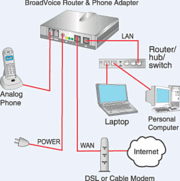
The world of Internet fraud is a constantly mutating animal. Phishing in particular is a rapidly growing problem and the latest mutation is the use of VoIP (Voice over IP) technology.
Using VoIP technology, the phishermen are luring the innocent into giving up sensitive personal and financial information by impersonating call centers.
Robert McMillan of IDG News Service reports:
Typically phishers email their victims, trying to lure them into revealing sensitive information on bogus websites. But instead of telling victims to click on a Web link, this attack asks users to verity account information on a phony customer support number.
"Part of the danger here is just the fact that it is novel," senior research scientist with Cloudmark, Adam O'Donnell, said. "Most people are pretty comfortable calling to a phone number that they think is their bank's."
Link to story from IDG News, here.
If you happen to see one of these Phishy e-mails, you can report it to the PIRT Phishing Incident Reporting and Termination Squad. This is a new service (volunteer driven) that actively goes after and takes down phishing sites.
Here is a previous post, I did on PIRT.
Subscribe to:
Posts (Atom)


