Showing posts with label counterfeit merchandise. Show all posts

Sunday, February 24, 2008

On eBay, the buyer better beware!

Despite a lot of publicity that eBay is going after fraud, the bottom line is that the buyer better BEWARE when they purchase something on eBay, or for that matter, any digital auction site.

This morning, I read a story from Wales, where a person just got caught selling laptops that didn't exist.

From the Evening Leader:

Christopher Malcolm Amos, from Green Lane, Shotton, admitted swindling customers of the online auction site out of thousands of pounds to fuel his gambling addiction.

Under the user name 'Whitefruit,' the 22-year-old accepted payments from 130 bidders wanting to buy laptop computers.

Some used eBay's PayPal facility, while others transferred the cash directly into Amos's bank account, but nobody ever received their orders.

Please note that at least some of the fraud victims used eBay's preferred method of payment, PayPal.

And Mr. Whitefruit, who I gather is a gambling addict, didn't get into very much trouble for swindling about 100 people. He was ordered to pay some restitution and got a 12 month suspended sentence.

I'm sure eBay fraudsters around the world are quivering in their boots!

I ran into another story in the ChronicleHerald (Halifax, Canada) describing a significantly larger operation involving selling neat "tech toys" that never existed:

Police said Wednesday several complaints about alleged electronic commerce crimes have come in during the past week to 10 days. Customers are from such countries as Australia, Sweden, Norway, the United States, Italy and Estonia. Const. Jeff Carr, a spokesman with Halifax Regional Police, said Canadian EBay users have allegedly been victimized as well, but there are no complaints from the Maritimes.
The person behind this, who hasn't been caught yet was selling laptops that didn't exist.

The story also indicates that PayPal was used on some of these transactions:

He said one complaint, from PayPal of San Jose, Calif., includes more than 100 alleged victims. PayPal, which was acquired by EBay in 2002, is an online money-sending service that provides users worldwide an opportunity to buy and sell goods without sharing personal financial information.

Even when you get the merchandise you paid for on an auction site, you are taking the chance that it is a cheap "knock off," or might be some of the stolen merchandise being fenced on some of these digital marketplaces.

Knock off merchandise can be dangerous when it doesn't work as well as the item it is passing itself off does. Buying stolen merchandise poses certain moral issues, also.

When buying something on an auction site, it is up to the buyer to make sure (beware) they are getting what they paid for. This can include using some good old "horse sense," and being able to realize when the deal you seem to be getting is a "little too good to be true."

Previous posts, I've written about fraud on eBay, can be seen, here.

Evening leader story, here.

I've also written about a company called buySAFE, who certifies sellers and guarantees what they sell. The seller pays for this -- and while I suppose the cost is included in their cost of goods sold -- this might be a good way to avoid fraud without having to do a lot of homework.

buySAFE's CEO, Steve Swoda does a blog, which I read from time to time can be seen by clicking, here.

Thursday, December 27, 2007

Symantec awarded $21 million award against Chinese Software Pirates

On Christmas Eve, Symantec announced a legal victory against Chinese pirates selling their cloned software at super cheap prices.

Please note, I stole the super cheap description from Symantec's video called, The 12 days of Christmas Spam." The super cheap tag can either refer to price, or the quality of counterfeit software (personal thought).

From the press release:

Symantec Corp. (NASDAQ: SYMC) today announced that it was awarded $21 million in damages against a large network of distributors selling counterfeit Symantec software.

The judgments were handed down by the United States District Court for the Central District of California in Los Angeles, CA in favor of Symantec against ANYI, SILI Inc., Mark Ma, Mike Lee, John Zhang, Yee Sha, and related defendants.

"Our customers are the real winners as a result of this case," said Scott Minden, director, Symantec Legal department. "A judgment like this is a crippling blow against these particular syndicates and will drive them even further underground, making it more difficult for them to sell directly to unsuspecting users. It complicates their ability to operate behind the guise as legitimate businesses."
The investigation conducted by Symantec in collusion with the FBI and Chinese authorities also led to some criminal charges being filed in China.

It appears that this particular case involved pirated software being made to appear as if it was the real deal. According to industry experts, the counterfeiting problem has increased 10,000 percent in recent history.

The software industry alone estimates it loses $40 billion a year because of pirated software. I wonder how many jobs this equates to?

Pirated (super cheap software) is also hawked via the millions (billions?) of spam e-mails attacking our in boxes in record amounts. Recently, Symantec issued a report based on the spam data they monitor revealing that over the current holiday season 71percent of all e-mail sent is spam.

Counterfeit software also can contain malware (malicious software), which can lead to your system becoming a zombie (part of a botnet to facilitate more spam) and even steal your personal and financial details. These details are then used to steal money either from you directly, or to steal money from financial institutions.

I'm sometimes amazed how a lot of current criminal activity ties in together via the digital world. All the average person needs to do is to watch all the spam messages they get and consider all the different schemes that are behind them. The schemes are nothing new, but the digital age has enabled criminals to reach out to more people than ever before.

Either this is occurring naturally, or someone pretty organized people are running operations along the lines of major corporations?

Besides the more personal dangers of buying pirated software, there is a lot of evidence the activity is making a lot of money for organized crime, rogue governments and terrorist groups, alike.

Press release from Symantec, here.

Sunday, December 23, 2007

Could buying that knock-off item fund the next terrorist attack?

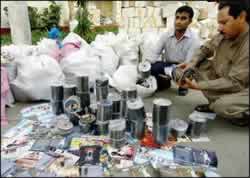
While this story is from a British perspective, it reveals how the trade in counterfeit (knock-off) merchandise is funding some pretty nasty characters beyond the borders of the British Isles.

Richard Elias recently revealed in Scotland on Sunday:

The sale of fake CDs, DVDs, clothing and perfumes in Glasgow and other British cities is helping to raise money for one of the world's most-notorious terror outfits – the group held responsible for the slaughter of US journalist Daniel Pearl in 2002.

MI5 is now targeting British-based supporters of Jaish-e-Mohammed (JeM), a pro-Kashmiri group dedicated to gaining the disputed territory its independence. Its aims include the "destruction" of the United States and India.

This isn't the first time the words terrorist organization and counterfeit merchandise have been used in the same sentence. And in reality, the problem goes far beyond the borders of the United Kingdom.

A good video about the counterfeit problem by KRQE in New Mexico is posted on YouTube, which can be seen, here.

The video references a report by the IACC (Internation Anticounterfeiting Coalition). The IAAC stated in a white paper that:

Low risk of prosecution and enormous profit potential have made criminal counterfeiting an attractive enterprise for organized crime groups. Congress recognized organize crime’s increasing role in the theft of intellectual property when it made trademark counterfeiting and copyright piracy predicate acts under the federal RICO statute (see 18 U.S.C. § 1961). Recently, ties have been established between counterfeiting and terrorist organizations who use the sale of fake goods to raise and launder money.

Counterfeiting is becoming a worldwide problem that poses a threat to the economy and public safety. Unfortunately, a lot of people view it as a victimless crime and continue to support it by purchasing knock-off merchandise.

If you take the time to read the IAAC White Paper, it also reveals that a lot of countries that we do business with in the global economy are some of the biggest culprits.

And the biggest offender seems to be China!

This should be no surprise considering the amount of unsafe product being found at your local store coming from that country.

While there are obviously more players in all of this than terrorist organizations, supporting any of them with our business isn't in the public's best interests.

IAAC White Paper, here.

Scotland on Sunday story, here.

Friday, December 21, 2007

$500 reward for eBay pirates selling super cheap (counterfeit) software

The Software & Information Industry Association is willing to pay up to $500.00 to anyone, who inadvertantly buys pirated software off an auction site.

Software piracy is a huge problem. The International Anticounterfeiting Coalition estimates that counterfeiting is a $600 billion a year problem. They also estimate that the problem has grown 10,000 percent in the past two decades.

More specific to the counterfeit software part of the all of this was revealed in a Business Software Alliance (BSA) and IDA white paper released in May estimating the problem at $40 billion a year.

Pirated software might not work as well as it is supposed to and it might even contain malicious software, which is often referred to as crimeware. The person, who puts this on their system is likely to have all the personal and financial details stolen and become an identity theft statistic.

Microsoft has a site to help consumers identify counterfeit software. Earlier this month, they filed 52 lawsuits and referred 22 cases for criminal investigation based on an investigation -- jointly conducted with the FBI and Chineses authorities -- into a counterfeiting syndicate based out of China.

Microsoft has also worked with eBay and information is also available on their site on how to avoid buying counterfeit software, here.

A lot of pirated software is sold on auction sites. The Software & Information Industry Association (SIIA) has launched a campaign to go after this problem on auction sites because they believe a lot of auction consumers are being defrauded when pirated software is sold as the real McCoy.

From the SIIA press release on this campaign:

“The sale of pirated software doesn’t only hurt the software industry,” said Keith Kupferschmid, Senior VP Intellectual Property Policy & Enforcement. “It also hurts consumers. Consumers feel “taken” when they buy software, only to find out when it arrives that the software is a fake -- they did not get an instruction manual or can’t get support from the software company. The Don’t Get Mad, Get Even program is a way for unsuspecting buyers to get even with auction sellers who rip them off by selling them counterfeit software.”

SIIA press release on reward, here.

Counterfeiting is a huge problem which hurts economies (takes jobs) and funds organized criminal and some say (terrorist?) activity. It also puts the person, who inadvertantly buys it at a fair amount of personal risk. Everyone can help fight it by reporting it to the SIIA, or the other links I've included in this post.

Despite what some people believe, counterfeiting is far from a victimless crime!

SIIA home page, here.

BSA and IDA white paper on counterfeit software, here.

Saturday, June 02, 2007

The new red menace, global commerce from China


You would think that we would have learned by now that products from China can be DANGEROUS for a variety of reasons.

Most recently -- our pets were poisoned and millions of dollars of products were pulled off shelves -- after it was discovered that pet food imported from China contained poisonous substances.

Washington Post article on this, here.

The FDA is NOW warning that they are putting antifreeze in oral hygiene products.

I guess poisioning our pets wasn't enough?

From the FDA alert:

FDA has identified the following brands of toothpaste from China that contain DEG and are included in the import alert: Cooldent Fluoride; Cooldent Spearmint; Cooldent ICE; Dr. Cool, Everfresh Toothpaste; Superdent Toothpaste; Clean Rite Toothpaste; Oralmax Extreme; Oral Bright Fresh Spearmint Flavor; Bright Max Peppermint Flavor; ShiR Fresh Mint Fluoride Paste; DentaPro; DentaKleen; and DentaKleen Junior. Manufacturers of these products are: Goldcredit International Enterprises Limited; Goldcredit International Trading Company Limited; and Suzhou City Jinmao Daily Chemicals Company Limited. The products typically are sold at low-cost, “bargain” retail outlets.


In case, you have used any of these products, the FDA recommends that you advise them in this manner:

Consumers can report adverse reactions or quality problems experienced with the use of these products to FDA's MedWatch Adverse Event Reporting program:www.fda.gov/medwatch/report.htm

(800) 332-1088

FDA news release concerning this, here.

My question is, given all this, maybe we should ban all commerce from China! The cheap prices aren't worth it. Perhaps, a little consumer mistrust, along with goverment sanctions might rectify this situation?

Other problems caused by free trade with China are counterfeit goods (including medicine), rogue websites (Internet fraud) and their army of hackers stealing everything from money to industrial and military secrets.

If you would like to read about other issues, I've written about, which are caused by "free commerce" with China, link here.

Saturday, April 07, 2007

buySAFE takes on the issue of counterfeit (knock off) merchandise

buySAFE bonds sellers after verifying they are reputable and honest. They also contribute their time to protecting the average person in the sometimes murky waters of e-commerce. Recently, buySAFE has been taking on the (huge) issue of counterfeit merchandise.

Consumers are protected when they buy from a merchant bearing the buySAFE seal. Not a very bad deal for the consumer! Bonding isn't free, but many merchants experience higher sales volumes after being accepted by buySAFE. Trust can drive a lot of sales! buySAFE is also a viable means for a merchant to protect their assets.

The Association of Certified Fraud Examiners noted in their last report to the nation that small businesses suffer "disproportionate fraud losses," when they are victimized by fraud. Large merchants can afford experts to deal with their fraud problems, however the cost is hiring experts can be restrictive for smaller merchants.

Of the numerous fraud issues found on auction sites, complaints about counterfeit goods rank pretty high. People buy items believing they are the "real deal," only to discover the item is a (knock-off) counterfeit.

Companies, who sell respected and trusted brands, are impacted by a loss of sales and consumer trust in their products, also. Some of them have already filed civil litigation against eBay because of the amount of knock-off (counterfeit) merchandise being sold on the site.

Even though auction sites offer seller rating systems, these ratings are often compromised when seller accounts are hijacked (taken over). eBay and PayPal (by most accounts) are recognized as the two most phished brands out there.

The intent of most of these Phishing schemes is to obtain personal/financial information to steal money (and or) take over legitimate accounts.

This can also happen when malware (crimeware) is inserted into an unprotected system and personal/financial details are stolen, normally using key logging software. Sadly enough, the criminal element has found it pretty easy to remain anonymous on auction sites, and few of them seem to get caught.

Whenever the Anti Phishing Working Group (APWG) releases a new report, both of these activities seem to set a new record that surpasses the previous one.

Recently, eBay seems to be taking the fraud problem a lot more seriously, but someone using the name of "Vladuz" is intent on proving their systems are easily compromised. A good place to keep up on the Vladuz saga is firemeg.com.

Although a good information source, I'm not certain that bashing Meg is the solution to fraud on auction sites.

Being the largest auction site, eBay is targeted by fraud all the time because of their popularity.

Fraud has already migrated to other auction sites, but they will always target the most popular.

The reason for this is simple (and it's only business for them) - there are more victims to harvest in popular places.

The term "Vlad" was based on a Romanian historical figure, Vlad Tepes, who inspired the novel, Dracula. In recent times, the term has come to signify fraudsters from Romania, who are well established and organized in the world of auction fraud.

Besides, protecting merchants and consumers, buySAFE makes a lot of contributions to addressing fraud issues on auction sites. Most recently, Jeff Grass (buySAFE CEO) has posted a lot of educational information on his blog about the counterfeit problem, here.

Jeff also appeared on the Today show, when they did a piece on counterfeit goods.You can view a clip of the show, here.

And the Today show isn't the only place that considers buy Safe’s views on the counterfeit problem important. The French government recently included buySAFE as part of a U.S. delegation (including government experts) to discuss the problem of counterfeit goods.

The INTERNATION ANTICOUNTERFEITING COALITION (a non-profit) sums up the problem when they state:

Counterfeiting is big business.It is estimated that counterfeiting is a $600 billion a year problem. In fact, it's a problem that has grown over 10,000 percent in the past two decades, in part fueled by CONSUMER DEMAND.

The real truth is people who purchase counterfeit merchandise risk funding nefarious activities, contributing to unemployment, creating budget deficits and compromising the future of this country in the global economy.

IACC site, here.

Part of the reason the activity has grown 10,000 percent is probably due to the explosion in e-commerce, especially on auction sites.

buySAFE seems to be doing a little more than just selling a product. In fact, they seem to be exercising some corporate responsibility by educating the public on fraud trends in the rapidly growing world of e-commerce.

Consumers can become a member of their Smart Buyer's Club, which leads you to a lot of good deals (safe to buy), here. Club members accumulate points, which can be redeemed for goods, or services (listed on the site).

Anyone claiming to be a buySAFE merchant can be verified, which can be done on the site, also.

Sunday, January 21, 2007

Does eBay now see fraud protection as an important part of their continued profitability?

There has been a lot written about fraud on auction sites, particularly eBay. Perhaps, with all the competition going after their "extremely profitable business model," they are reconsidering the importance of preventing fraud on their site?

Mark Raby of the TG Daily writes:

During a webcasted conference with some of the online auction site's top sellers, eBay's North America president Bill Cobb expressed concern over the rise of people who don't ship out items or list counterfeit merchandise as real, along with people who have found more clever ways of manipulating the system.

Cobb said that one key target that could more easily be monitored is the selling of fraudulent and pirated merchandise, which is not always easily caught or reported by the buyers, or the wording in the auction is deceptive so that the victim has no means of restitution.

Top-end products, like cars and jewelry, will also be on Ebay's watch list as it puts new measures into place to ensure that both the buyers and sellers are legitimate. With around two billion new items put up for sale every year, it has historically been difficult and financially unmanageable to have a comprehensive anti-fraud program for the site.
TG Daily story, here.

Although - as always - "money talks," it's great to see some forward motion on this issue, which has left too many people "holding the bag."

Here is a previous post, I wrote about competition forcing more "fraud protection" in the auction world:

Will competition make it harder to write off fraud costs on auction sites?

Monday, July 03, 2006

How to Protect Yourself on eBay

Kathleen Day of the Washington Post did an excellent article on "Self Defense for E-Bay Buyers," where she took an in depth look at fraud on eBay and came up with some pretty good suggestions on how to protect yourself.

In her own words:

"Goods that are damaged, counterfeit, don't match what was advertised or are never delivered remain a persistent problem for eBay and its customers -- even though the numbers represent a relatively small fraction of transactions on the Web site. How big a problem is unclear. EBay Inc. does not disclose specific totals."

She interviewed Ina Steiner of Auction Bytes, who clarifies this; despite eBay claims to the contrary:

"Ina Steiner, editor of AuctionBytes, an online newsletter that follows eBay and other electronic auction sites, said the estimate does not include many unresolved disputes that exceed the company's time limits for consideration or were not counted for other procedural reasons. It also does not include cases in which customers persuade their credit card company to cancel the charge. And Steiner points out that by comparing confirmed cases of fraud with the number of goods listed rather than the number of actual sales, eBay makes the percentage seem smaller."

In 2005, the NCL (National Consumers League) listed auction fraud as the most prevalent type on the Internet. Interestingly enough, eBay removed the link from their site to them (which tabulated the complaints) so the percentage might be higher than they reported.

For the full story - which contains some excellent tips on how to protect yourself on eBay - here is the link.

For a new service, which protects buyers and sellers on eBay:

buySAFE Protects it's Customers from Fraud on eBay

Sunday, April 30, 2006

Counterfeit Goods, A Borderless Problem


Counterfeit goods are a worldwide problem. With the global economy, the companies being counterfeited are spending a lot of money to try to stop the problem. But have they been successful?

The Daily Times of Pakistan is reporting:

A long campaign to remove pirated goods from shop fronts in Asia is finally having an impact but the crackdown has also changed the nature of the problem and new outlets are flourishing. The results of police raids, a slate of new laws and increased prosecutions can be seen across the region on the back streets of Beijing, Hong Kong, Taipei, Singapore and to a lesser extent Phnom Penh and Hanoi.

To counter the authorities, black market buccaneers are shifting their goods from roadside stalls and shopping malls to the Internet. Su's team now also conducts daily patrols of Internet sites. His point was echoed by industry observers in Mumbai and Seoul, where much like Bangkok and Jakarta, it's business as usual with counterfeit products brazenly on display in the tourist precincts.

In other words, the people behind counterfeiting are very adept at mutating their method of operation and carrying on.

Link to Daily Times article, here.

Of course, we in the West can blame Asia and the third world for this activity, but if weren't for people in the West buying these goods, I doubt it would have grown into an international (worldwide) problem.

AND the companies being counterfeited probably have something to worry about. With the popularity of Internet auctions, the business of counterfeiting goods is likely to grow. Internet auctions are big business and sites, such as eBay refuse to accept blame for the actions of their members. The sale of counterfeit goods is rampant on these sites and Tiffanys and Microsoft are spending a lot of money bringing legal action to try to curb it.

Some of these companies might be contributing to the problem in another way. After all, do you think all the $100.00 tennis shoes we buy are made in North America, or Europe? Not very likely in the global economy. In the quest for cheap labor, long regarded as one of the major expenses of doing business, many of our goods are produced in the same countries that produce the counterfeits. The end result is counterfeits of about the same quality as the item being counterfeited.

I doubt there will be any significant impact on this problem until all parties involved clean up their acts. We can blame and prosecute counterfeiters in far-away lands, but as long as there is a demand and a ready means to distribute these goods, the problem isn't going away.

I recently read a book by Tim Phillips, "Knockoff," which is best analysis of the situation I've seen.

If you are interested, I would highly recommend reading it.


Sunday, January 29, 2006

How Much Fraud Can eBay's Customers Endure

Fraud on eBay is making news again, this time for upset customers being sold counterfeit goods. Here is an article by Katie Hafner of the New York Times:

"A year ago Jacqui Rogers, a retiree in southern Oregon who dabbles in vintage costume jewelry, went on eBay and bought 10 butterfly brooches made by Weiss, a well-known maker of high-quality costume jewelry in the 1950s and 1960s.

Rogers thought she had snagged a great deal. But when the jewelry arrived from a seller in Rhode Island, her well-trained eye told her all the pieces were knockoffs. Even though Rogers received a refund after she confronted the seller, eBay refused to remove hundreds of listings for identical "Weiss" pieces. It said it had no responsibility for the fakes because it was nothing more than a marketplace that links buyers and sellers.

That stance — the heart of eBay's business model — is being challenged by eBay users such as Rogers who are starting to notify other unsuspecting buyers of fakes on the site. And it is being tested by a jewelry seller with far greater resources than Rogers: Tiffany & Co., which has sued eBay for facilitating the trade of counterfeit Tiffany items on the site.

If Tiffany wins, other lawsuits would follow and eBay's business model would be threatened because it would be nearly impossible for the company to police a site that has 180 million members and 60 million items for sale at any time."

For the full story, read: eBay users fed up with fakes.

eBay hasn't only been in the news recently for being a marketplace for counterfeit goods. In a recent post, I covered the problem of stolen goods being sold and merchandise being purchased with fraudulent financial instruments.

Also covered in this post is the growing problem of buyer/seller accounts being hijacked. This normally occurs when a seller becomes a victim of phishing, or is tricked into giving up their account information to a seemingly legitimate eBay request via e-mail. The e-mail links them to an official looking eBay site, where they are asked to "validate" their account information. Should someone fall for this, the criminal has all the information necessary to hijack the account and use it (the account) to conduct fraudulent business.

Although, eBay's official policy is to support law enforcement requests without a subpoena, it takes them 10-20 days to honor these requests. If criminals have access to multiple accounts and fraudulent financial tools, the trail is likely to be pretty cold in 10-20 days.

Here is my post on that activity: Better Teamwork is an Opportunity.

eBay is also getting a reputation for Advance fee fraud (419) activity. On auction sites, fraudulent buyers offer to buy something and send a financial instrument to the seller for more than the asking price. They then dupe the seller into negotiating the instrument, which is counterfeit and wiring the excess money (less a commission for the seller) overseas. When the instrument is discovered to be fraudulent (often much later), the seller is held accountable and could even be charged with a crime.

Counterfeit Postal Money Orders, Cashiers Checks and a new type of instrument, OChex (checks ordered electronically over the internet) have all been used in these frauds, which are becoming collectively known as auction scams.

Over the Christmas season, we saw another scam, where XBox packaging was being sold as the real thing: XBox Latest Lure in Auction Scams.

I wrote this in a recent post, eBay Needs to Protect Those that Line it's Pockets:

"My message to the folks at eBay is that they better take a look at upgrading their "authentication systems" and hire some extra security staff. Blogs like mine and many others are trying to educate the very people, who are making them billions and they blame for allowing themselves to be scammed. eBay is no longer the only the only game out there and if they fail to protect those who line their pockets, they are likely to go elsewhere."

Perhaps a few legal actions will wake eBay up?